Blog Birthday and a Competition

Today is my blog’s third birthday! I had planned a big celebration, but, as seems to be the norm lately, time got away from me. I do have an exciting announcement though…

There is a fanfiction competition happening to coincide with the release of a collaborative story collection titled The Life and Times of Chester Lewis, of which I am one of the contributing authors (alongside some great writers, such as Michael White who co-authored Private Oz with James Patterson). The collection follows the life of the title character, Chester Lewis, through the decades from the 1930s through to the 2030s (I pick up the story during the 1980s). The fanfiction competition is open to writers worldwide and has a fantastic first prize (plus anyone who enters is eligible to enter the Chester Lewis Fan Fiction Group where you will receive regular fiction writing tips and have discussions with fellow writers).

Thanks so much to all my blog followers and readers, new and old, for always making me smile with your comments, follows and likes over the past three years!

Photo a Day Challenge

Has anyone else heard of the ‘Photo a Day’ challenge. It’s run by FatMumSlim who can be found on Facebook and Twitter or on her blog fatmumslim.com.au.

I’ve seen many people on my Facebook friends list doing this challenge throughout the year and love seeing their takes on the different prompts, so this month I decided to give it a go. (Here is the September prompt list).

I love writing through prompts. Several of my published stories were inspired by prompts. My children’s story ‘Green Nadine’ was inspired by the prompt ‘green’. My recently published short story ‘A Troll for Christmas’ was inspired by the line ‘Troll the ancient yuletide carol’ from the song ‘Deck the Halls’ and is one of my favourite stories to date.

I’m hoping one of the photos taken from these prompts might help inspire a picture book this month for 12 x 12, or at least help get my creative juices flowing by getting my mind to think in different ways.

The great thing about prompts is they are so open to interpretation and can be taken in so many different directions. No two people will interpret a story prompt in exactly the same way (just look at the other two stories in Deck the Halls that were inspired by the same line as my story–they’re completely different to my interpretation.)

In the spirit of talking about prompts, here is a prompt for you:

OUTSIDE

You can use it to write a story in any genre or even as a photo prompt. Be as creative or as literal or as metaphorical as you want. Have fun!

And the Worst Blogger Award goes to…

I’m feeling like the worst blogger in the world at the moment! Winter is always terrible for illnesses in our household. As a result, it is also terrible for keeping up with blogging.

I hope you’ve been enjoying the guest posts over the past months, hopefully with spring only days away and bubs’ naps becoming more routine I will be able to return soon!

There won’t be a Helpful Writing Sites and Blog Posts post again this month, but hopefully those will be returning soon, also.

I hope everyone who went to Write on Con enjoyed it and got a lot out of it, I know I did.

Why Writers Should Blog on the Side (Guest Post)

As writers, most of us have heard the advice that blogging is a great way to help build our author platform, but today’s guest blogger, Debra Johnson, offers some other good reasons why writers should blog.

Why Writers Should Blog On the Side

Whether you are writing the next big novel or writing a column for work, all writers should have a personal blog that they write for on a weekly basis.It sounds like a lot of work to be writing more but there are many benefits to writing a blog on the side:

  1. Practice makes perfect: The more you write the better your professional writing gets. Just like the old age saying ‘practice makes perfect’ still rings true through your adulthood and creative career. When you write a blog, your readers and their comments are a wonderful way to gauge your writing process. Not only do positive comments propel you to continue down the correct writing path but negative comments are beneficial. Don’t allow negative comments get you down;they are wonderful constructive criticism for you to edit and mold your work into something better. Personal blogging can help you learn from your mistakes and grow from them, as well as find the good in your writing and further improve it.
  2. Helps with future ideas and creativity: Keeping a personal blog is a key to your future writing career. So many ideas, phrases and themes from your personal blog can be used in your professional work. When we write personal blogs the pressure is off and the creativity is on. There are no boundaries and rules when writing a personal blog; therefor your ideas are unhindered and inhibited. When you are working on your professional piece, look back through your blog posts and archives to gather ideas.
  3. Stress relief and writers block: Being a writer you know that you have your off days and your on days. It seems that more often than enough, you tend have to several off days more than your on days. Writing on a personal level can help you get through your professional and paid project. Keeping those creative juices flowing by writing on the side will help decrease that worry and frustration that come with writers block. Writers block hits us when we least expect it and the only way around it is to charge it full on with blog writing.

Writing a personal blog is healthy for your creativity in your personal and professional writing career. It’s a win-win for all, first you help your writing, entertain others and your career is heightened. So head to your nearest online blog spot and start blogging today! Happy blogging!

About the Author:

 This guest post is contributed by Debra Johnson, blogger and editor of nanny payroll.

She welcomes your comments at her email Id: – jdebra84 @ gmail.com.

Tuesday 12 x 12

If you pop over to Julie Hedlund’s blog, I’ve done a guest post on why I decided to join 12 x 12 in 2012 and what I’ve got out of it so far. Julie Hedlund is the super-awesome founder of 12 x 12 in 2012 and it was a pleasure guest posting in her 12 x 12 series.
Speaking of guest posting, I have a new guest post lined up to post in the coming days on why writers should blog. You’ll notice things have been a bit slow around here lately. I was having some issues with my blog (all resolved now) and my family got hit by an extremely nasty ‘flu (all better now fingers crossed).

Writing Secrets You Won’t Learn in Class (Guest Post)

Phew! These past two weeks of school holidays have been busy, busy, busy! Now that school holidays (and the plethora of illnesses that have plagued our household) are over, I can hopefully get back to some regular blogging (plus look out tomorrow for a new anthology launch).

I’ve had this guest post lined up for a few weeks and I’m so glad to be back on the blog so I can post it for you. Thanks to Melissa Miller for writing it.

Writing secrets you won’t learn in class

Many creative writing workshops offered in high school and college operate under a certain set of rules and guidelines. These are meant to help a young writer shape their prose or poetry to a fine point so they can produce the best work possible. You know the conventional wisdom offered in many of these courses: write what you know, build a compelling narrative, create a multidimensional character, and use appropriate grammar. If some of these tips seem like common sense to you, you’re not alone.

While many writing classes offer a stellar introduction to creative writing, many more offer run of the mill advice that won’t do much to impact that career of a burgeoning writer. While no one expects any one class to fit all the complexities of writing in their syllabus, there could stand to be a more varied conversation. There are so many things that college writing courses and fiction seminars don’t teach you about the writing process. Allow me to share a few unconventional bits of wisdom that I’ve learned in my experiences as a writer.

Embrace new experiences as future writing material

This bit of advice is instrumental for those writers who have yet to travel. I can tell you from experience that a little sightseeing—whether it’s a weekend trip to a new city or a months-long trek across Europe—will do wonders for your writing. The richness of travel simply lends itself to great storytelling. There’s something about the experience of putting yourself in an entirely unfamiliar setting that just gets your creative juices flowing.

It’s also commonly believed that the more experiences you have to draw from, the more depth that you can then add to characters as you flesh out a story. Think about the range of experience the separates a writer who’s traveled the country from one that has lived in their hometown all their lives: there’s a good chance than one’s writing will be far more varied and diverse than the other’s writing. of course, traveling doesn’t’ make you a good writer, but it can certainly help you develop ideas and expand your worldview.

Don’t be afraid to write poorly

I advise any writer to avoid whatever slows down their writing. in my view, one of the biggest roadblocks to productive writing is the editing process. I’ve met far too many writers who were worried about perfecting the words, grammar, and overall structure of every sentence to the point where it interfered with their actual story. Yes, editing is a critical part of the writing process, but it’s by no means the most important part. You have to have an actual story before you can edit it.

In this vein of thought, I advise writers to continue writing a story, chapter, or section of their work without paying much heed to the overall look of their work. It’s much better to get your thoughts written on paper (or on a Word document) first, no matter how messy that jumble may turn out to be. There’s plenty of time to edit once you’re done with the first draft. Just write!

Sometimes it’s alright to tell rather than show

It’s the hallmark of any advanced creative writing class: show, don’t tell. While that device will certainly make aspects of your narrative more compelling, it’s by no means the only way to tell a great story. That’s right, I’m telling you that sometimes it’s acceptable to tell, not show. The appeal of “showing” in a story is that the author doesn’t spell out salient plot points or character developments for their readers. They drop subtle hints and show the characters and situations for what they are, hoping that the reader will pick up on the nuances.

You might be surprised to learn that a writer can be equally poignant if they tell the reader certain details of a story. Perhaps the narrator tells a reader certain things about a character which interestingly contrasts with the actions they carry out in a story. Or perhaps you simply want to tell some details for the sake of expediency—it’s not a writing sin, no matter what your teacher tells you.

What are some unconventional writing tips that you’ve learned along your writing journey? Let me know!

This guest post is provided by Melissa Miller. Many of Melissa’s other articles aim to help you understand the challenges and benefits involved in earning an online associates degree, and show you a way through the often confusing process. She welcomes questions and suggestions at melissamiller831@gmail.com.

The Halfway Mark for 12 x 12!

As of the end of June the 12 x 12 in 2012 challenge will have reached the halfway mark. To celebrate, 12 x 12 creator, Julie Hedlund, is hosting a blog party where participants can share their progress so far and either celebrate or commiserate.

Here’s my little update…

PB manuscripts finished so far: 11! (thanks to NaPiBoWriWee in May I have a few extra)

PB manuscripts started, but not finished: 4

Successes: My February PB was published in an online magazine. (You can read it here.)

Submissions: Apart from the one I submitted to the online magazine, I currently have a couple submitted to some PB competitions, but it’s too early to have heard anything from them yet. I’m yet to submit any of them to publishers (most of them still need a lot of work and revision and I  have more polished work that I’ll be submitting before my 12 x 12 MSs).

I’m really enjoying the challenge so far, not just because I’m building a great folder of PBs to work on, but because the support and friendship within the 12 x 12 group has been invaluable. I hope everyone else participating is getting something out of it, whether it’s new PBs or great friends. If you’re not participating, it’s not too late to join in; we still have six months left to go!

Storytelling Secrets to Make Your Novel Unforgettable (Guest Post)

Freelance writer Lucy Faraday is back guest posting again today with a post on secrets for an unforgettable novel (you may remember her recent guest post on Poor Man’s Copyright).

Storytelling Secrets to Make Your Novel Unforgettable

If you’re an author you’ve likely been given countless tips and techniques to make your stories really shine. The reality is that there are (unfortunately) no magic wands that you can simply wave to create the next Harry Potter or A Song of Ice and Fire series. There are, however, a few well-kept secrets that many authors already employ without some people even realising it. These concepts, ideas, and tips help to keep a story not only going along at a lightning pace, but also keep the readers glued to the pages, eager to know what happens next. The aim is to keep your readers laid back and glued to their seat desperate to continue reading simply by creating characters and situations that really bring your story to life. And it’s probably much easier than you think. So without further ado, here are the storytelling secrets you need to make your next novel truly unforgettable.

Collect interesting names

One of the biggest challenges facing authors is naming their characters. Some writers are able to simply pluck them out of the air and have them sound great first time, but others need to take a little more time over it. Many famous novels feature unforgettable character names (examples include Albus Dumbledore, Jon Gatsby, Tyrion Lannister, and so on). If you have a hard time generating memorable character names on the spot, here’s a handy tip: keep a notepad (or your smartphone) handy, and whenever you come across a good name in your day-to-day life, jot it down. Then, when you come to name your creations, you’ll never be at a loss for words.

Give your characters a signature

In order to leave a lasting impact on readers, writers need to make the characters as memorable as possible. Not just in terms of name as we discussed above, but also in their mannerisms and the way they talk. To make your characters really stand out, one good idea is to give each of them a signature of some kind. This could be a limp, an eye patch, a noticeable scar, a vocal tick – the list goes on. The aim is to make the reader feel like they really know a character and could recognise them anywhere. That way, your book will be much more memorable.

Give your readers mental landmarks

In much the same way as you’ll want to make characters recognisable, you may also do the same with setting and environment. For example, if you were writing a yarn about pirates and two of the characters were having a swashbuckling sword fight, would you simply place them on a ‘sandy beach’? If you do, your reader doesn’t have much to go on. But put them instead on the edge of a cliff teetering above a rock formation that resembles a human skull and you’ve created an instantly memorable mental landmark. It’s things like this that turn a good book into a great one. Mental landmarks work anywhere, not just during action sequences. They allow readers to truly build the world in their mind, and their immersion in the story gets a boost at the same time.

As Faulkner said, “Kill your darlings”

William Faulkner was one of the proponents of the great American novel, and he was also a font for writing knowledge. One of his most famous quotes is “In writing, you must kill all your darlings.” – but what does this mean for modern authors? Well, simply put, it means that you mustn’t become too heavily attached to characters. If you do, your story runs the risk of becoming stale. By building up a character and really falling for them, then dealing them a fatal blow, you’ll throw a spanner in the works and create tense moments that will remain with your readers forever. If you need any tips on how best to eliminate characters that you may have spent hundreds of pages creating, take a leaf out of George RR Martin’s book. In A Song of Ice and Fire, he kills more main characters than we can count!

So there you have it: just a handful of ways you can make your next book unforgettable. The same rules apply whether you’re writing a 1000-page tome or a short story, so don’t feel like you have to write a novel to try these out. With a little work, and a little effort, you’ll find your writing (and the immersion it offers readers) will only grow in time.

Helpful Writing Sites and Blog Posts April/May 2012

I seem to have accululated quite a few links on promoting yourself as an author the past two months, from having a great author bio to having a professional headshot to hitting #1 on Amazon. Speaking of Amazon, don’t forget you can still get free copies of Eighty Nine for Kindle until 5.59pm AEST tomorrow (Friday). That’s 11.59pm Thursday US Pacific time and 8.59am Friday UK time. You can see my previous post for more information and links.

And now to the helpful posts for April and May…

Writing

Writing the Longer Picture Book

Mara Rockliff talks about writing longer picture books (over 600 words), including important tips for authors to keep in mind when writing a longer picture book.

8 Apps Every Writer Should Have

A list of 8 helpful writing apps for your phone, including a story tracking app for those who are in the process of submitting queries and a rhyming app for poets/picture book writers.

Ideas for Story Structure

I’ve seen a lot of different ways to plan out story structure, but I just love the simplicity of this idea. It’s not only a simple way of plotting out your novel/short story/picture book (yes, it can equally be applied to all three), it manages to incorporate the main points of the story arc. I’ll definitely be using this system in future.

Promoting Yourself as an Author

Five Ways to Fix a Boring Bio

Whether you’re published, unpublished, querying, have a Twitter or Facebook account or a blog, at some point in your writing career you will need to write an author bio (multiple times!). Think you’re boring? Or haven’t done enough yet? This post offers 5 simple and logical ways to spice up your author bio.

The Seven Worst Mistakes of Indie Authors and How to Fix Them

If you are taking the self-publishing route, this post by Joanna Penn is a must-read. She has some great advice, with solutions to oft-made mistakes by self-publishers. She speaks from the experience of someone who has been down the self-publishing path and had to learn from her own mistakes.

Amazon Bestseller: Top Ten Tips for Hitting #1 on the Amazon Store 

A post from author Rachel Abbot, whose book has topped the Amazon charts. She shares her experience of starting out thinking all she had to do was upload her book and the profits would roll in, to discovering the key factors to marketing her book successfully.

Author Business Cards

A literary agent, who is not generally a fan of business cards, talks about how to make a stellar business card that won’t get thrown in the trash. Some really great tips!

Mastering Your Author Headshot

Author August McLaughlin offers some helpful tips on making sure your author headshot gives the right impression and how you can get the most out of a headshot photo session. She includes an interview with headshot photographer Ken Dapper.

Eighty-Nine on Kindle FREE!

If you’re anything like me, you love getting free stuff. I was really excited when the editor of Eighty Nine (in which my story ‘Eighteen for Life’ is published) announced we’d be having some promotional days over the coming months. Eighty Nine has just recently been released on Kindle and starting 6pm tonight (AEST) it will be available to download FREE for 48 hours! How exciting is that? For those like me who are terrible with working out timezones:

US- Pacific Time 12:00am Wed 30th May – 11:59pm Thurs 31st May

UK 9:00am Wed 30th May – 8:59am Fri 1st June

Aust 6:00pm Wed 30th May – 5:59pm Fri 1st June

Here are the Amazon links:

Amazon US

Amazon UK

If you don’t have a kindle, not to worry, you can download Kindle for PC for free from Amazon.

If you haven’t heard me talk about Eighty Nine before, here is a bit of a blurb and explanation on how the anthology came about:

BLURB

1989: a cusp between decades.

The year the Berlin Wall came down and Voyager went up. Ted Bundy and Emperor Hirohito died. The birth of the first Bush administration and computer virus.

In San Francisco and Newcastle the ground shook, in Chernobyl it melted.

Tiananmen Square rocked the world and Tank Man imprinted on the international consciousness. Communism and Thatcherism began their decline, Islamic fundamentalism its rise.

It was the year Batman burst onto the big screen, we went back to the future (again), Indiana Jones made it a trifecta at the box office and Michael Damian told us to rock on.

Based on a play list of 26 songs released in 1989, Eighty Nine re-imagines the social, political, cultural and personal experiences at the end of the decade which gave the world mullets, crimped hair, neon-coloured clothing, acid-wash denim, keytars, the walkman, Live Aid, the first compact disc and MTV.

Some Back Ground

The third literary mix tape EIGHTY NINE, based on a playlist of 26 songs from the year 1989, went on sale in October 2011. Editor Jodi Cleghorn randomly assigned a song per author and asked them to create a story around the song that reimagined the events of 1989 through a speculative fiction lens.

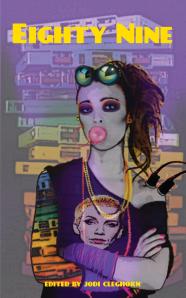
Blake Byrnes, a final year fine arts student, turned an accidental promo photograph into the ‘eighties grunge’ cover, based on the character “Amiga” from Dale Challener Roe’s story Shrödinger’s Cat. Byrnes’ artwork provided the visual template for the character of “Amiga” in Devin Watson’s live action book trailer.

The Book Trailer

http://www.youtube.com/watch?v=bom-dnS8r9Y

There are some great stories inside by some fantastic authors. Enjoy!

P.S. Here is a review of Eighty Nine from dark fantasy and horror writer/reviewer, Alan Baxter.


A writing blog