
 A couple of weeks ago I interviewed the lovely Fleur McDonald (author of the Australian novels Red Dust and Blue Skies). I am lucky enough to have a short story appearing in the same anthology as Fleur (Australian Literature: A Snapshot in 10 Short Stories). Today Fleur has posted an interview with me on her blog where I talk about my writing, balancing writing with motherhood and a little bit on my short story in the anthology.
Seven Picture Books in Seven Days
 Writing seven picture books in seven days is a lot harder than it seems. I’ve just finished NaPiBoWriWee where that’s exactly what I had to do.
Finding Ideas
On some days the ideas came easily. One morning I woke up with an idea already formed in my mind. Other days inspiration didn’t come quite so easily. In fact, it got to seven o’clock one night and I was fretting that I wouldn’t find an idea at all. Some of my ideas were sparked by the world around me (a picture book set on a farm) or a memory (the theme song to Postman Pat reminded me of a funny line my siblings and I used to sing when we were younger and it formed into a picture book idea). Some of my ideas came out of thin air (such as the one I wrote about a pirate) or from staring out the window blankly (what if there were fairies in the garden?) Asking my son for ideas didn’t work out very well as all he wanted to do was count (hence one of my picture books ended up being a counting book), though he came up with some good character names for one of my picture books.
Time
For the most part I waited for my children to go to bed before I sat down to work on my picture book for the day. On a couple of days my son was my sounding board while my daughter napped. The fact we went on holidays with two days of NaPiBoWriWee to go left me worried I wouldn’t get those last two picture books for the week written. As it turns out our very long car trip gave me a lot of time to think and work out a story in my head (which I typed up on my laptop the first chance I got) and my final idea was inspired by the trip itself.
The Writing of a Picture Book is a Complex Exercise.
Although picture books appear simple on the surface, it is their simplicity that makes them complex to write. Writing picture books is a lesson in using concise language. Word choice is especially difficult as it mustn’t be too flowery or difficult for a child to comprehend, yet an odd word every now and then that encourages the child to explore language beyond their own vocabulary enriches the text. Picture books tend to have a rhythm and flow, whether a rhyming text or straight prose. It must sound right when read aloud.
Far From Finished.
The picture books I wrote for NaPiBoWriWee are no where near finished, they are simply rough drafts. Two of the picture books I wrote will probably never be explored further as I just don’t feel I like them enough or that they have enough potential. Some of my other ideas I really love and I will definitely be revising and reworking them until they’re polished. (My picture book critique group can expect to see some of them in the near future!)
Did you do NaPiBoWriWee this year? How did you go? Was it easier or harder than you anticipated? If you didn’t do it, is it something you would consider doing in the future?
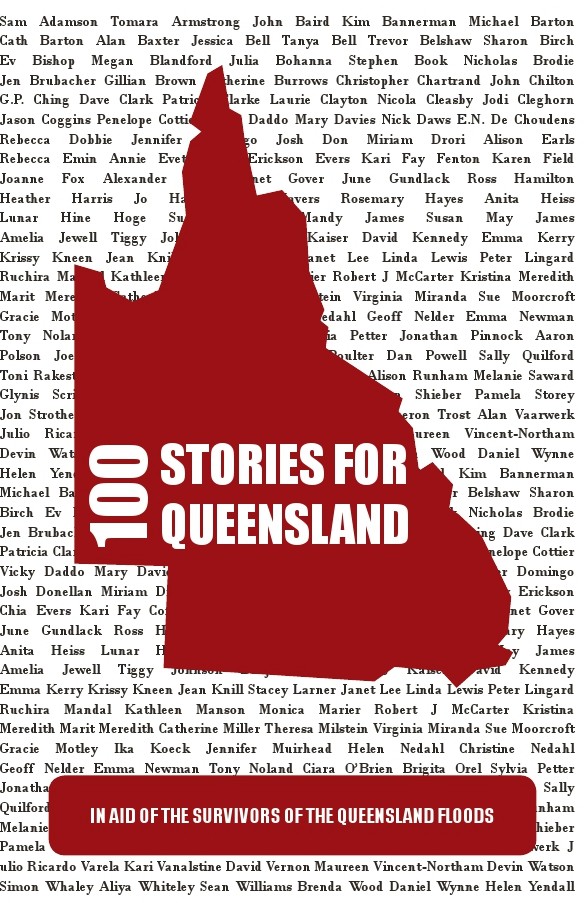
100 Stories for Queensland – A Review
 A devastating flood…
In late December last year and early January this year Queensland, Australia was hit by devastating floods. At one time or another, floods covered ninety per cent of the state. Crops were destroyed, homes and lives were lost. Watching the devastation unfold in the media left me with a feeling of horror. The stories that came to surface had me in tears.
The call…
On the 11th of January Trevor Belshaw put out a call on Twitter and Facebook “100 stories for Queensland?”.
The response…
Authors from around the world submitted upbeat and uplifting stories of fiction. One hundred of those stories were chosen for an anthology whose purpose is to raise money for those affected by the floods. Those working behind the scenes, such as editor Jodi Cleghorn, have worked hard and done an amazing job compiling those stories into a beautiful book.
The launch…
On the 3rd of May the eBook of 100 Stories for Queensland was launched and can be bought on the 100 Stories for Queensland website (you can even read a free sample of stories before you buy). In a fortnight the print version of 100 Stories for Queensland will be available from Amazon and the Book Depository and may be ordered from your local bookstore.
My Review
After being brought to tears by Kate Eltham’s beautiful introduction, I’ve been reading through the fantastic collection of stories contained within 100 Stories for Queensland. Here is just a snapshot on my thoughts on a few of the stories.
John Baird’s ‘The Safe Option’ is a very clever story. I loved the twist.
Kim Bannerman’s ‘The Turtle Inventory’ is cute and funny. All those turtles!
Alan Baxter’s ‘The SpeakingTree’ is a tale of life. I loved the old fig tree.
Stephen Book’s ‘After All These Years’ has great characterisation. It reminds me of one of my favourite series: the Sookie Stackhouse novels by Charlaine Harris.
Gillian Brown’s ‘The Anniversary’ has a funny ending.
Christopher Chartrand’s ‘The Carver’s Daughter’ is a sweet story. It almost made me cry.
Jennifer Domingo’s ‘One Tenth of a Second’ is a story of unbeatable odds and doing your best anyway. It brought a smile to my face.
Karen Field’s ‘Amunet’s Gift’ is very sweet. It has great visual imagery.
Emma Karry’s ‘Confessions of a Toddler’ gave me a good giggle. It reminded me of a certain little toddler living in my house.
I’m only two thirds of the way through reading all the stories so far, and I’m looking forward to reading the rest of them.
I feel privileged to be included amongst these talented writers and to be a part of something raising money for those affected by the floods. It’s such a great cause, I hope you will consider buying a copy to help out. I know I will be buying a copy (or two). Remember 100% of the sales from the eBook and 100% of the wholesale price of the paperback (excluding printing costs) go to the Queensland Premier’s Flood Relief Fund.
NaPiBoWriWee 2011
 May 1st to May 7th is National Picture Book Writing Week. The idea is to write 7 picture books in 7 days. I had a lot of fun doing it last year and came up with some great ideas. Like NaNoWriMo, it’s a great way to get yourself writing. And though the idea of writing a picture book a day seems easy on the surface, it’s not! It’s a great challenge. I’m still polishing some of my ideas from last year. If you’re a picture book writer, consider having a go. It’s a rewarding experience.
If you want to find out more just visit here.
Helpful Writing Sites & Blog Posts April 2011
 It’s been a huge month this month with some great posts celebrating Aussie Author Month. You can visit here for links to the weekly round ups of posts around the web related to Aussie Author month.
Onto the monthly round up (and don’t forget, all these links will be added to the masterlist, which you can find at the top of my blog).
Writing
In the style of Query Shark, and run by two literary agents, the idea is to submit the first 250 words of your manuscript for critique.
What the Fiction Editor Looks For Part 1
Literary agent Rachelle Gardner points out what an editor looks for in regards to characters. Some great points to keep in mind when revising your manuscript.
Checking for Plot Holes: Does Your Story Add Up
A list of questions to ask yourself to make sure you haven’t left any plot holes in you novel.
How to Make Your Most Ordinary Scene Interesting
How to recognise a boring scene and what to do about it.
10 Tips to Keep in Mind When Naming Your Character
Author Jody Hedlund gives some advice on naming characters.
The Seven Habits of Highly Effective Writers
Doing at least one of these can help improve your productivity as a writer.
10 Lies You Might Tell Yourself When Editing
Do you tell yourself these lies when editing? This list will either give you a laugh or make you hide your head in shame.
Top Ten Reasons You Should Rewrite That Scene
A literary agent intern’s guide to why a scene is not working in your manuscript and some tips on how to fix it.
We see a lot of posts on how to write spare or cut down the word count of a novel if the novel is too long, but I tend to write spare to begin with and often fall short on word count. This post has some tips on bolstering your word count (without padding it out with unnecessary words).
Standing Out in the Slushpile: Some Basic Tips
Some tips on increasing your chances of being picked from the slushpile as observed by an editor. Can be applied to short story submissions or novel length stories.
Your Book is Coming Out… Now What? – 5 Easy Things to Get You Started
Where to begin when promoting your book after it’s been published.
The 50 Things Every Graphic Design Student Should Know
I know this is aimed at graphic design students, but a lot of the points can equally be applied to writers. For example, “If your work doesn’t excite you, then it won’t excite anyone else. It’s hard to fake passion for mediocre work – scrap it.”
Picture Books
5 Rules for a Breakout Picture Book: A Quick and Dirty Guide
An editor gives 5 tips on making your picture book great.
5 Tips for Creating Characters for Kids
Character development is not just important for novel length manuscripts, it’s important to create fully developed characters for children’s stories and picture books as well.
Queries
The Call – Questions to Ask the Agent
An agent likes your manuscript and wants to offer you representation. Now what? A printable list of questions to ask when you get ‘The Call’.
Cover Art
Designing Your Cover – Part One: Concept Part Two: The Rough Draft Part Three: Revisions, Titles and Printing
This is a three part series for self-publishers on designing an effective cover for your book.
Social Networking
This list highlights the little things you can do to make your site more effective. It comes with a printable checklist.
Your Facebook Fan Page – 11 Tips to Captivate Your Audience
It’s sometimes hard to know what to do next once you’ve set up your author page on Facebook. This post gives some tips on how to attract and keep people on your page.
3 Reasons to Interview Other Authors on Your Blog
A self-explanatory title. The 3 reasons are very convincing.
Just for Aussies
What Makes Australian Authors Tick?
The up sides and down sides to being an Australian author.
Author Interview with Fleur McDonald
 I’d like to welcome Australian author Fleur McDonald to my blog. Fleur is the author of the novels Red Dust and Blue Skies and is one of the authors featured in the soon-to-be-released anthology Australian Literature: A Snapshot in 10 Short Stories.
Can you tell us what inspired you to write the short story ‘Gone’, which will be appearing in the anthology Australian Literature: A Snapshot in 10 Short Stories?
I was wanting to branch out a bit from my normal farm/rural type stories, but still with a mystery/crime basis. It took me a little while to come up with the storyline and I was hesitant about my short story writing skills, having not written many before. It took a lot more drafts than what my novels do!
(You have nothing to be hesitant about, I loved reading your story ‘Gone’.)
‘Gone’ is quite an emotional story. As a mother it really hit home for me as it plays on every mother’s worst fears. Did being a mother yourself make it easier or more difficult to write this story?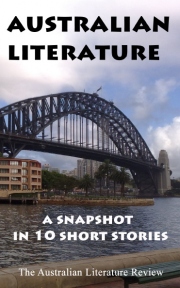
I’ve lost quite a few family and friends to cancer and I know the difficulties faced by the families and friends of the dying. Trying to imagine my own children in that situation is quite frightening and the whole time I was writing Gone, there was this terrible sinking feeling, sitting in my tummy.
Because of that, it did make difficult to write, but the experiences I’ve already faced, with this type of situation, meant I could make it realistic and in turn that part was easier to write.
In ‘Gone’ you write from Detective Indy Sullivan’s point-of-view. What made you decide to write from Indy’s point-of-view, rather than the parents or even fellow detective, Jack?
I’m not sure. Indy sort of jumped into my mind and stayed there. Writing it from Jack’s point of view would be an interesting experience. Maybe I should try that!
 How do you balance writing with being a mother and living on the land?
Well, it’s always a juggling act, especially this time of the year, when it hasn’t rained and we’re busy feeding animals every day. I often only write once a week, on my day in town. If I get any more time than that, it’s a bonus.
(I can totally relate! We’re lucky to have had a lot of rain this season on this side of the country, which isn’t always the case. It’s great you can make that time for your writing.)
Your published novels, Red Dust and Blue Skies, are both based on the land in rural Australia. How much are your own experiences living on a farm reflected in your novels?
Well, I guess the most experience I draw on is the setting – living where I do, makes it easy for me. The plots that I put my characters into, thankfully, I’ve never experienced.
As it’s Aussie Author Month this month, can you tell us about some of your favourite Australian Authors and how they’ve influenced/inspired your own writing?
Tamara McKinley, Belinda Alexandra, Rachael Treasure, Monica McInerney and Tony Parsons are just a few that have influenced me. Tamara, Belinda and Monica all write such wonderful sagas and I wanted to be able to do that in a rural setting – that’s where Rachael and Tony come into it – but with a crime influence (most of my crime favourites are American or English).
There’s many more that have inspired me, since I started to write and I’ve met them, either face to face or through the social media. Katherine Howell would now be one of my favourite crime writers.
What are you working on at the moment?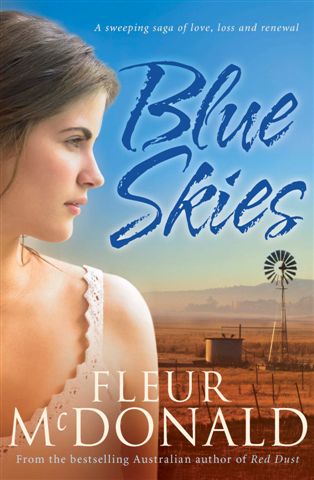
My third book Purple Roads is due at the publishers in July and I’m nearly finished. I’m heading to Perth this week as my daughter is having a large operation and I’m hoping to finish it while I’m up there.
(I hope all goes well with your daughter’s operation.)
Any words of advice for aspiring authors?
Never ever give up. Just because your MS isn’t wanted one day, doesn’t mean it won’t be wanted the next.
Fleur McDonald grew up among the farming communities of Orroroo in SA and now lives east of Esperance, on 8,000 acres. Here, she cares for a husband, two children and a menagerie of dogs, cattle, sheep and a bit of crop, not to mention tractors and other machinery!
Fleur is the best selling author of Red Dust and Blue Skies, both published by Allen and Unwin. When she has five spare minutes, she is writing her third and forth books, Purple Roads and Silver Gums.
For more information visit www.fleurmcdonald.com or follow her on Twitter @fleurmcdonald or Facebook http://www.facebook.com/pages/Fleur-McDonald/204949640064?ref=ts
For more information on Australian Literature: A Snapshot in 10 Short Stories visit The Australian Literature Review.
Pitch Contest on YAtopia’s Blog
YAtopia is currently holding a pitch contest involving Literary Agent Natalie Fischer. This is a great opportunity as Natalie is currently closed to submissions, but some lucky entrants will have the chance to submit to her after the competition! You’ll have to hurry though because today is the last day to enter (sorry for the late notice), but there are still quite a few spots available.
http://yatopia.blogspot.com/2011/04/pitch-contest-with-natalie-fischer.html
Aussie Author Month – Graeme Base

 I have long loved Graeme Base‘s books; they are amazing in both prose and illustrations (of which he does both). Although I focused on a picture book author last week, Graeme Base writes for older readers (from upper primary school children to adults).
Fantastic Detail
Before I discuss his writing, I just have to pay tribute to Base’s stunningly beautiful and detailed illustrations. These highly detailed illustrations are not only beautifully drawn on a surface level, in many of his books they include hidden pictures, intricate details and even clues. Some examples:

The Waterhole
(Notice the hidden monkey in the bottom left or the tarantula on the right? There are ten hidden animals on this page worked into the detail of the trees, etc.)
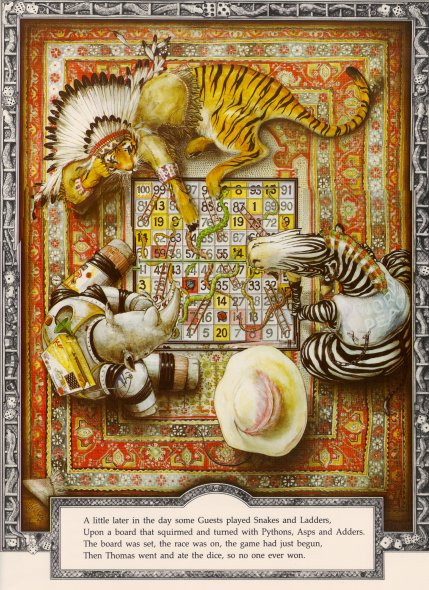
The Eleventh Hour
(Why yes, the numbers on the game board are out of order… a clue perhaps?)
Clever Prose
 The detailed illustrations are complemented with clever, and often witty, prose, including well-written rhyme and alliteration.
“Diabolical dragons daintily devouring delicious delicacies.” (Animalia)
“Now Bertie knocked at Number Four… but silence reigned supreme.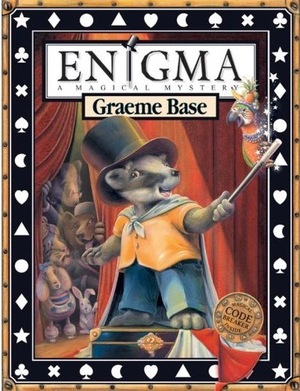
The door swung open soundlessly, as if it were a dream,
For this was where Miss Poodle lived, ‘The Mademoiselle of Mime’,
And for an hour, without a sound, she acted out the crime.” (pg. 14, Enigma)
Picture Books for Older Readers
 With the exception of The Waterhole and perhaps Animalia (as they can both be enjoyed by younger readers), the majority of Graeme Base’s picture books are aimed at older primary school readers (or even adults). They include complex language, mysteries to get the reader thinking and a sense of adventure. They often also include historical and geographical references.
“Sorry to hear the raid was a bit of a flop, but I don’t see how it was my fault. I can’t help it if the Ancient Britons are onto us and have moved inland. Frankly I think the bottom is falling out of this Viking business and we should look at reindeer farming or something instead.” (pg. 6, The Discovery of Dragons)
“That night Sprocc played his music as he never had before,
A sea of sound that rose and fell upon a rhythmic shore.
‘Nice meshing, Sprocc-groob!’ Stickman called. ‘You’ve really got it down!
This joint ain’t heard a mesh like this since SkatMan came to town.’” (The Worst Band in the Universe)
Graeme Base’s books need to be experienced in person to fully understand how clever and beautifully illustrated they are. It is easy to spend hours immersed in their pages.
A side note in regards to Aussie Author Month:
One of the aims of Aussie Author month is to raise awareness and funds for the Indigenous Literacy Project – a project that aims to raise Literacy levels amongst Inigenous Australians living in rural and remote communities. You can learn more here: http://www.indigenousliteracyproject.org.au/ and you can donate to the project as part of Aussie Author month here: http://www.gofundraise.com.au/page/ausbooks
Best Australian Blogs 2011 People’s Choice
 I’m very excited to announce my blog is up for voting in the People’s Choice section of the Best Australian Blogs 2011 run by the Sydney Writer’s Centre.
If you would like to vote you can click the link here (I’ll also put a link up in the sidebar): Best Australian Blogs 2011 People’s Choice
There are lots of other fantastic blogs you can vote for too (including a few of my favourites).
Please note: There are two Jo Harts in the competition. My blog is on the last page under ‘The Graceful Doe’.
Aussie Author Month – Mem Fox
 In Australia we are spoiled for fabulous picture book authors (and illustrators). From the clever prose and gorgeous illustrations of Graeme Base (Animalia; The Waterhole) for older picture book readers to the endearing storylines of Margaret Wild (There’s a Sea in My Bedroom; Kiss, Kiss!) for younger picture book readers. From Australian picture book classics which Australian children have been reading for generations, such as May Gibbs’ Snugglepot and Cuddle Pie, to newer picture books, such as Kathryn Apel’s This is the Mud. A favourite picture book author of mine, and of my children, too, is Mem Fox. We have many of her books on our bookshelf and they are much requested at bedtime. So what is it about Mem Fox’s books that makes both parents, teachers and children alike keep reading them over and over again?
Rhyme
Many of Mem Fox’s books are written in rhyme. As a writer who loves to write picture books, I know just how hard rhyme is to pull off effectively. It’s not just about finding the right words to  rhyme, it’s also about rhythm and flow. Mem Fox’s rhymes always flow naturally and beautifully, giving her stories a lovely lyrical quality.
“It’s time for bed, little fish, little fish,
So hold your breath and make a wish.” (Time for Bed)
“Here is the near sheep. Here is the far sheep.
Here is the moon sheep. And here is the star sheep.” (Where is the Green Sheep?)
 Australiana
Mem Fox’s use of Australian animals as characters—characters who personify the Aussie spirit— tied in with other pieces of Australiana (food, places, slang terms), make her books feel like home to Australian readers, who can relate to familiar images and language evoked by Fox. International readers are introduced to peculiar creatures and new experiences from the land ‘Down Under’.
“Later, on a beach in Perth, they ate a piece of pavlova.
Hush’s legs appeared. So did her body.
‘You look wonderful, you precious possum!’ said Grandma Poss. “Next stop—Tasmania.’
And over the sea they went.” (Possum Magic)
“One night, beside a low camp fire,
They heard the men talk loud
about a boatrace way out west
That’d make all Aussies proud.
One said he’d give his two eye teeth
To be there at the race.
‘My oath, too right!’ the other said,
With longing on his face.” (Sail Away: The Ballad of Skip and Nell)
Repetitive Language
 Young children love books with repetitive language and, when reading aloud, children will often join in because they can pick up on the repetitiveness. They can predict what will be said on the next page. My preschooler son will sit down with a Mem Fox book and read the book to himself from memory because the repetitiveness of the text, combined with the pictures, means he can easily remember the story and the words. This is a great precursor to learning to read. Mem Fox’s books are perfect for this pre-reading stage.
“‘Good grief!’ said the goose.
‘Well, well!’ said the pig.
‘Who cares?’ said the sheep.
‘So what?’ said the horse.
‘What next?’ said the cow.” (Hattie and the Fox)
“And her sister said,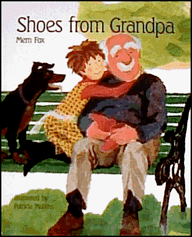
‘I’ll get you a sweater when the weather gets wetter,
to go with the blouse with the ribbons and bows,
to go with the skirt that won’t show the dirt,
to go with the socks from the local shops,
to go with the shoes from grandpa.’” (Shoes from Grandpa)
Page-turning Storyline
 Mem Fox’s stories are written in such a way that the reader just has to turn the page to find out what happens next. The stories often build to the climax. Where is that green sheep? What can Poss eat to make her visible? Will Skip and Nell make the race in time?
If you’re a writer of picture books, check out this very interesting article on Mem Fox’s site about her process for writing Where is the Green Sheep? http://www.memfox.com/green-sheep-secrets.html There are some fantastic gems of advice in there, including this:
” After twenty one years of writing for children, I’ve come to appreciate that the books young children like best fall broadly into two categories: either short books with a pattern, based on rhyme, rhythm or repetition; or short books with a really good story. They don’t like nostalgia books. They don’t like first person books. And they don’t like long books. Stories, or patterns: that’s it.”
For a great overview of Australia’s most popular children’s book authors, have a look at this article: http://www.cultureandrecreation.gov.au/articles/childrensbooks/
A side note in regards to Aussie Author Month:
One of the aims of Aussie Author month is to raise awareness and funds for the Indigenous Literacy Project – a project that aims to raise Literacy levels amongst Inigenous Australians living in rural and remote communities. You can learn more here: http://www.indigenousliteracyproject.org.au/ and you can donate to the project as part of Aussie Author month here: http://www.gofundraise.com.au/page/ausbooks
And don’t forget to check out all the other exciting things happening for Aussie Author Month.

 Jo Hart - Author