I have to start this post by yelling very loudly “I DID IT!” I reached 50,000 words on the 30th November (today) at 4.10pm Australian time. I’d actually fallen behind my word goal the last few days, meaning I had to write around 2,100 words today to hit 50k. It was very exciting putting my 50,000 words into the NaNoWriMo word count evaluator and receiving my winner’s certificate. Thank-you so much to everyone who cheered me on and supported me throughout the month of November. And in case you don’t believe me, here’s my NaNoWriMo page (complete with my final word count).
Now onto the helpful websites and blog posts for the month of November. There aren’t quite as many as usual, since I’ve been writing more than scouting for sites, but there were a few good ones. I’ve even included a few at the end for those finishing up NaNoWriMo and in need of a laugh.
The bluestocking blog did a great round up of helpful and insightful posts relating to NaNoWriMo earlier in the month, but there are quite a few helpful writing links in there worth checking out even though NaNo is now over.
The first post in a blog series on writing novel queries, this post outlines the five elements that should be included in your query, and follows up with some examples.
Anyone who is an official NaNoWriMo participant would have got this in their inbox during November, but if you’re not an official participant or you never got around to opening the e-mail you should read this. Quite funny.
Humourously outlines all those amateur mistakes we writers make when we first start writing by speaking with a fictional character who is the result of bad writing. (I’m sure a few of our NaNoWriMo characters are still in this stage until we go back and start editing.)
Weren’t we all that naive when we first started out, before we started reading agent blogs and realising there is more to writing than just slapping words on a page? I got a good giggle from this video.
A big congratulations to everyone who particpated in NaNoWriMo this month, whether you reached 50,000 words or not.
Last year I attempted NaNo for the first time. I only got 25k. I managed to finish the novel a few months later and have recently just finished editing.
THIS YEAR
The plan…
This year I had four story ideas I was throwing around, I finally decided on the one I had the most ideas for since I figured it would make it easier to write. I planned it all out, I had an outline, I had character bios, I even knew what I wanted to happen chapter by chapter (I’m a real planner when I write, I like to know what’s going to happen before I start.)
November starts…
I started out slow. Really slow. In the first week I got a total of 3000 words. I had the ideas, I knew what I wanted to happen, I even had the time (since I’m not working at the moment). I just wasn’t feeling motivated. By the end of the week I knew it just wasn’t working and it was a choice between giving up completely or starting something new.
Second attempt…
I thought I might switch to the sequel for my last year’s NaNo, since I already had a few ideas for it and I was already in my characters’ heads from all the editing. I wrote 100 words and realised I needed the month break from that universe I’d promised myself (after all I’d been working on that story non stop for a year already).
Finding the right story…
I thought about the remaining two stories I had on my back up list and decided I didn’t feel the pull for either of them. There was only one thing left I could pursue. What had been my major distraction during that first week? A new book series I’d discovered a few months ago and which I’d just recently finished reading. Every time I didn’t feel motivated on my story I would read fanfic pertaining to this series. I’d written fanfic in the past (as I mentioned in my guest post on Harry Potter for Writers last week), why not try my hand at a new fandom?
Motivation finally…
The first day I started writing my fanfic novel I wrote 7851 words in one day! That’s more than double my word count from the entire week before. I’d found my motivation. The following days I wrote 5k a day. By day 9 I’d surpassed the daily word count goal and kept ahead. I couldn’t believe I was writing so much by the seat of my pants with no real plan and only the vaguest of ideas of where I wanted the story to go. It’s scary in a way, I’ve never written anything this long without a plan before.
Motivation dwindling…
Last week my motivation started dwindling. It was a combination of a couple of reasons. Firstly I hit a spot in my story where I’d written a really climatic scene and found I wasn’t really sure what I wanted to happen next (the downfall of writing with no plan). Secondly morning sickness kicked in. It probably wasn’t the smartest idea planning to get pregnant when NaNo was about to start and I knew morning sickness would kick in sometime in November. I planned to power through. Not so easy when my stomach is churning and I’m feeling tired on top of that and I just want to go to sleep. We’ve also been hit with some really hot days here the past few days, so that’s compounded my lack of motivation. Monday I wrote nothing at all.
Where I am now…
My total word count at the moment is just over 38k, I’m sitting right where I should be for my daily word goal, but have lost the lead I built up earlier. I need to hit 40k by the end of today to keep on track. I’ll have to keep fighting through the morning sickness, fatigue and heat if I want to hit 50k by the end of the week. Wish me luck!
NaNoWriMo this year has been a real rollercoaster ride so far, full of highs and lows. I know in the end I won’t have a publishable novel, since I’m writing a fanfic, but it’s a nice break from the editing I’ve been doing on my original novel. Perhaps I’ll find a fanfic site to post it on.
I hope wherever you are on your NaNo journey you just keep writing. There’s still a week to go, anything could happen! And no matter what our word counts are by the end, whether we get 50k or not, every single word is an accomplishment. Every word makes us better writers (and so will all the editing when we’re finished). Good luck to all my fellow NaNoers as you partake in the final week!
Today I’d like to welcome Catherine Johnson to my blog. Catherine is a writer whom I met through Write on Con a few months ago and we have since formed a picture book critique group together (along with some other writers we met through Write on Con). Catherine is currently beta reading my MG fantasy and giving me some great feedback.
Knowing I’m in the middle of pounding out 50000 words in a month for NaNoWriMo, Catherine kindly offered to do a guest post for my blog. So without further ado, here is Catherine with her post on writing dialogue.
Thank you to Jo for letting me guest post today. I chose to talk about dialogue and share some tips and trips. It’s something I am very interested in doing better and listening and reading good dialogue can only serve to help the cause. At the bottom of this post I have listed some of my favourite quotes from movies I watch with my kids all the time. I’m sure there are many more, if I had all day 🙂 There are 8 great tips on dialogue here: http://bit.ly/UZraC They are very specific and useful to try yourself. Everyone likes to think their character’s say things that are true to life. Have a look at the tips on this site and check the against your writing: http://bit.ly/9Q6DxY All those of us with young children are lucky that the first few tips are already taken care of. I like the last one, I might try that with my main characters. Another useful post on the subject is here: http://bit.ly/a7hQMH discussing expository dialogue, a common pitfall of writing dialogue.
Absorb all the dialogue you hear around (without being too nosy! coughs) especially from tv shows and films. Reading is also an obvious example. Have you ever read a picture book, for example, and only concentrated on the dialogue? Are there books in the library that seem to have more dialogue than others? Analyse it and see if it appears natural and see how it fits in with all those tips and tricks above. And now I’ll leave you with some of my favourite lines from movies I watch way too much!
The Bee Movie
Vanessa Bloom “It’s very hard to concentrate with that panicky tone in your voice.”
Bee Vincent “It’s not a tone. I’m PANICKING!”
Space Chimps
HAM “When are you going to stop worrying about me dad? Space is in my veins.”
Dad “And between your ears.”
—————
“Chimp up cannonball. You’re not in the circus anymore.”
————–
HAM “You’re not going to do that the whole trip are you?”
Friend “What?”
HAM “Use Chimps to replace real phrases.”
————-
HAM “I do this every day of the week (sky dive) except Monday. That’s my me day.” (I particularly like this one!)
“…this rug isn’t going to cut itself.”
G-Force
“Hey I’m nine inches tall,I only see the up-side.”
Catherine
Thank-you so much, Catherine, for your post. You’ve provided some great links. If anyone would like to check out Catherine’s blog, you can find it here: Kangaroobee’s Blog
P.S. A little update on my NaNoWriMo progress: I started out with a slow week, I was finding it hard to get motivated for the story I planned, even though I knew what I wanted to write. Yesterday I decided to throw that story in and started something completely new. I wrote more yesterday on the new story than I had all week on the first one. I’m feeling a great deal more motivation now.
In my last blog post when I was talking about preparing for NaNoWriMo I mentioned character bios. This week I’m going to go into character bios in-depth. I find writing outlines or bios for my main characters helps me get a good feel for my character before I start writing and I find I can slip into their voices much easier. These are some of the ways I prepare my characters:
Harry Potter
1. Character Biography/Outline Sheet
This is a page (or pages) of information/facts about my character. This is where I take a vague idea in my head and start nutting out the details of who my character is. I’m going to use the character of Harry Potter as an example to show you how I set out my character bio sheet.
Name: Harry James Potter (if my character goes by a nickname I include it here too)
Age: 11 years, born 30th July
Nationality: British
Physical features: Dark, messy hair that always sticks up at the back; green eyes; wears cousin’s oversized hand-me-down clothes; wears glasses; skinny and scrawny.
Family: Lives with his aunt, uncle and cousin because his parents died when he was a baby (killed by dark wizard, but he believes they were killed in car crash). They are a middle class family and live in a three bedroom home. Uncle works for a drilling company. Harry is treated badly by all members of the household and his bedroom is the cupboard under the stairs.
Strengths: humble, kind to others, willing to fight for what’s right
Weaknesses: quick temper, disregard for rules, curiosity that leads him into trouble
Power: Wizard (I include this one for my fantasy novels)
I may add more bits and pieces to this as I write, for example I may come back and include his address 4 Privet Drive, Little Whinging. Character sheets are a good way to keep track of details as you write so you don’t end up with character inconsistencies (eg: he has green eyes in chapter one, but blue eyes in chapter twelve).
2. Character Interview
While the character sheet gives a basic overview of the character, and interview goes more in-depth. During the interview have your character answer in their own voice. This is a good way to develop your character’s voice. These are some of the interview questions I use (and I’ll use Harry Potter as an example again). Describe your family. Parents, siblings, pets, alive, dead…
My mum and dad died when I was a baby, so I live with my mother’s sister, my aunt Petunia, and her husband, my uncle Vernon. I’m basically fungus between their toes. They dote on my cousin Dudley. He’s a spoilt brat and about as wide as two houses. Bullying me is his favourite sport. I don’t have any pets, aunt Petunia thinks animals are too dirty to be allowed.
If your house was on fire and you only had time to grab three things, what would they be?
I don’t really have anything worth grabbing, all my stuff is hand-me-downs from my cousin Dudley and it’s all rubbish.
Are you religious at all, and if so, in what way?
No. Although aunt Petunia makes us all go to church on Sunday at the local Anglican.
What is your race/social status?
I’m caucasian. I suppose you could say we’re middle class, although aunt Petunia likes to think we’re upper class.
If you are at school, do you think you fit in? If not, why? (For an adult character you can exchange school for work)
No I don’t. Dudley always made sure of that. He bullies me daily with his group of thugs. No one dares make friends with me because they’re too scared of Dudley and his gang.
What is the one thing you care about most in the world?
I don’t really have anything or anyone. I know I should say my aunt Petunia, but I doubt she cares about me. I wish I had a photograph of my parents.
If you had to spend the rest of your life doing one thing only, what would it be?
Living as far away from the Dursleys as possible.
What’s the last thing you’d be caught doing?
Bullying others
What was the best experience of your life, and why?
Probably when my parents were still alive, but I can’t really remember. I have this vague memory of this woman smiling at me, but I don’t know if it’s real or not.
What was the worst day of your life?
The day Dudley and his gang chased me into a stinging nettle bush. Uncle Vernon wouldn’t even let me put cream on the stings because he said it served me right not looking where I was going.
Describe the sort of person you’d want to marry, if you married at all.
Someone kind and who loves me for me.
What do you look for in a friend?
Someone who actually wants to hang around with me and who is a decent person (I wouldn’t want to be friends with someone who is mean to others).
If you go to school, what are your favourite and least favourite school subjects, and why? (For an adult character you can change this to work duties)
My favourite subject is sport, mostly because I know I can always outrun Dudley. My least favourite is art, because Dudley and his mates flick paint and bits of dried clay at me when the teacher’s back is turned.
If you could go anywhere in the world, where would it be?
Anywhere that isn’t Little Whinging. I’d like to find out where my parents lived and go there.
Sum yourself up in five words. (You can also ask how they would sum up other main characters in the story)
skinny, orphan, friendless, independent, smart
You might have noticed I answered the questions from the perspective of Harry as he would answer prior to the events of the books. You could also do an interview of how your character would answer during the events of the story, obviously Harry would answer differently once he’d started at Hogwarts, had made some friends and was away from the Dursleys. Here’s an exercise to try: Answer these questions from Harry’s perspective after he starts Hogwarts (or if you haven’t read Harry Potter chose a character from another book).
3. Character Picture.
A character picture helps give you a solid image of what your character looks like. Here are some of the methods I use:
Sketch – I’m not a great artist, but sometimes I like to grab a pencil and sketch out what my character looks like. What would he/she wear? What hair colour/length does he/she have? What colour eyes?
Sims – This is one of my favourite methods, especially with the more recent versions of Sims, because there are a lot of options for creating your character’s physical appearance. You can adjust skin tone, eye colour, hair style, build, clothes style, even nose and mouth shape. You can also choose your character’s personality (and in Sims 3 you can also choose life goals). When I’m done creating my character I print screen and save the picture. If you don’t have Sims, there are various sites around with ‘dolls’ you can design to look like your characters (although the problem with many of these is they don’t often have male dolls).
Character from my wipCombined collage of four main characters from my wip
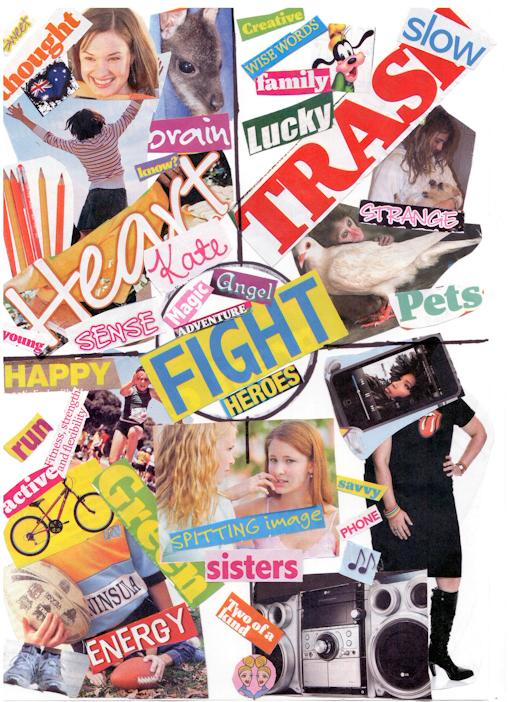
Character Collage – For this one I grab a stack of old magazines and search for pictures relating to my character. I’ll look for people sporting the same style of clothes or hairstyle or I’ll look for objects relating to my character. For example, when doing a collage for my character Ava I’d look for pictures of people with short red hair or black clothes and pictures of ipods and phones. It’s a good way to show physical appearance and personality.
With only a week to go until NaNoWriMo begins, this week I will be focusing on my characters and getting to know them better. I’d be interested to know what other methods you use when getting to know your characters.
Wow! I can’t believe one year ago today I made the very first post on this blog. I started this blog with the intention of sharing my writing journey with others, as well as sharing information and helpful links I found along the way. The blog has changed appearance in the course of the year (a new header, new theme, handy page links at the top and a cute little Twitter link), but the intention has always stayed the same.
By far the most popular posts I make are the ‘Helpful Website and Blog Post’ editions I post once a month, compiling all the helpful sites and writing information I’ve come across in the past month. (Look out for an award ceremony later today where I’ll be awarding some of my favourite sites of the past year.)
Lots has happened along my writing journey. I finished my YA novel and I’m currently in the last stages of tweaking it. My picture book story ‘Can You Jump Like a Kangaroo‘ came third in the Smories 2nd International Short Story Competition. My short story ‘Waiting on the Docks‘ was featured on The Australian Literature Review website. And I’ve met so many fantastic and supportive fellow writers through chats, forums and Twitter.
A big thank-you and lots of love to all those who follow my blog or even just visit occasionally.
xxx
PS Stay tuned, I will be posting throughout the day. I have lots of exciting things planned. And don’t forget the contest for 3 people to win a 5-page critique from both Peevish Penman and myself ends today, but if you’re quick you can still enter: Blogiversary Contest Details
PPS Don’t forget to pop over and wish a Happy Blogiversary to Peevish Penman too: Peevish Penman. Happy Blogiversary Carrie!
Back in February I talked about how I planned to do my first lot of revisions once I finished the first draft of my manuscript. Now I have finished those initial revisions, I am now doing more revisions (does it ever end !) so I thought I would dedicate a post to what my focus is in this part of the revision process. First a brief recap of what I did for my first lot of revisions.
FIRST ROUND REVISIONS
Main focus: Structure and technical elements
1. Listen to chapter read aloud on ywriter and highlight flaws.
2. Read chapter, fix spelling and grammar and make additional notes.
3. Go back over highlighted parts of text and rewrite (highlighted parts generally indicate telling rather than showing and awkward phrasing)
4. Read aloud chapter to myself and fix anything else that stands out.
SECOND ROUND REVISIONS
Main focus: Tightening manuscript and fixing plot flaws
1. Delete all unnecessary words, descriptions and anything not relevant to the plot. This includes getting rid of words like ‘that’ and backstory that contributes nothing to the plot. I also deleted the entire prologue.
2. Make a list of plot holes then go back and fix them.
3. Rewrite beginning (multiple times) until it hooks the reader.
4. Raise the stakes! Delete anything boring and add more conflict.
5. Restructure chapter breaks. Instead of ending chapters at mundane natural breaks (like falling asleep at the end of one chapter and waking up the next morning at the start of the following chapter) use chapter breaks in high-tension places to hook the reader into the next chapter.
6. Create more natural dialogue between characters.
7. Work with critique partner to pinpoint flaws I have overlooked and to see what impressions a reader would have of the manuscript in its current state.
What do you do when you revise? Do you follow a similar structure or do you revise in a completely different way?
What a busy week! NaPiBoWriWee officially ended at midnight on Friday. (See Paula Yoo’s NaPiBoWriWee 2010 wrap-up blog post here) I managed to get four and a half picture books written. It wasn’t the seven I was aiming for, but I’m still quite happy with what I got written. It was a great learning process. If you think writing a picture book a day is easy, it’s not! I learned that putting myself into my son’s world is a great way to find inspiration for picture book stories. I also learned that asking a three-year-old for ideas is not such a great idea (My story about a red button, a lion, a kitchen and a girl was a huge flop). A couple of my stories are still quite rough, and I didn’t finish the story idea my 3-year-old suggested because it just wasn’t working for me. One of the stories I really quite like and I want to revise it and polish it up at some point. For now though I’m going back to revisions on my novel.
For those who participated you may be wondering what you can do with those picture books you wrote during NaPiBoWriWee. I mentioned in an earlier post a website called smories.com where every month picture book writers have the opportunity to submit a picture book story. The best 50 are chosen and videos of children reading them are posted on the site. I just found out my picture book “Can You Jump Like A Kangaroo” has been shortlisted this month and the video of a child reading it will be posted on the site on the 1st of June! If you want to submit a picture book story to their newest competition just go here:
If you know of any other picture book opportunities I would love for you to tell us about them in the comments.
I would also love to hear how others did for NaPiBoWriWee. Did you get 7 books written in 7 days? Or, like me, did you find real life made it difficult to find the time to get them all done? Maybe your muse left you halfway through. Did you learn anything along the way?
“Write with the door closed, rewrite with the door open.” STEPHEN KING
I read that quote this morning and I thought it really resonated with the topic I was intending to blog about today: being flexible and keeping an open mind when writing. When writing the first draft you probably have a good idea in your mind of what you want to write about, you may have even planned everything out and written in down. So you shut out the world and just write, getting all your ideas down on paper, then comes the rewrite and this is when you need to keep an open mind.
As a teacher, and particularly as a substitute teacher, I find that being flexible is an important aspect of my work. Some days I walk into a classroom to teach for another teacher and they have the day planned out for me, other days there is no plan at all and I have to come up with a days worth of lessons on the spot. Every day is with a different class too, so I never know what to expect when I walk into the classroom. Some days I have a lovely well behaved class who do all their work, other days I have a volatile mix of students who like to see how far they can push me. I think being flexible as a teacher can be transferred to being flexible as a writer.
In some parts of my novel there are scenes that fit well with my plan and don’t need much work apart from a little tweak here or there to fix the technical errors and reword the awkward phrases. Then I get to other parts and I realise I need to scrap the whole passage and write it again from scratch. Then there are the characters, who are a bit like my students. In some parts of the story they are quite well-behaved and I am happy with their characterisation. In other parts, however, they just don’t want to cooperate, there are voice issues and the characters seem flat.
It can be difficult to prune a story you have poured your heart and soul into and spent hours writing. In my first draft I had written a prologue, which I loved. It was the first thing I wrote when I sat down to write my novel and the idea for it had been floating around in my head for quite some time. I liked the way the entire passage flowed and was pleased with the imagery I had created with the descriptions, but in the end I had to cut it from the story. As much as I was attached to it I had to admit that it was unnecessary. The prologue started with characters that would not appear again in the entire story (apart from being briefly mentioned by another character) and the information included in the prologue could easily be incorporated into the story elsewhere. By cutting out the prologue I’ve created a stronger story.
As you rewrite be honest with yourself and be open to change. Be willing to stray from your original plan to make a stronger story. In my original plan I had a certain ending in mind, which I wrote in my first draft, but on reflection I realised it is not a strong ending. My original ending was really just a set up to lead into the next book (since I plan to write a series), but my novel would not work well as a stand-alone book if I ended it in that way. I had to rethink the entire ending to make it more defined and to allow the book to feel finished as opposed to a lead into the next book of the series.
When you finish your first draft try leaving it for a few days before beginning your revision and when you do start revising try to go in with an open mind and a willingness to be flexible. Let go of your preconceived notions of sticking to your plan and instead look at what works and what doesn’t. Don’t be afraid to prune unnecessary parts or rewrite entire passages to strengthen the overall story. It can be a daunting process, but in the end you will have a better story.
Last week I felt a great deal of pride and accomplishment as I typed the final words of the first draft of my novel. It felt so good to know that I had just written over 50,000 words/20 chapters and got all of the plot that had been floating around in my head all typed up. But of course I am by no means finished my novel, and as much as I felt relief at finally get my entire story written down, I also knew I still had a big task ahead of me: editing.
The prospect of editing this novel is a bit scary, to be honest, since I wrote most of it without looking back, so I’m prepared for lot of typos and sentences that make no sense. In the past I have taken the approach of editing a lot as I write, constantly going back, revising and correcting. I decided to take a different approach this time around, mostly inspired by the NaNoWriMo process. So I wrote this novel without looking back, I let my muse take over and just typed, without worrying about typos and other writing disasters. Now I cringe to think what terrible descriptions, spelling mistakes and illegible sentences I will find as I proofread the finished product. Despite this, I actually think it is a good thing in a way because I will be proofreading with fresh eyes. Since I haven’t looked back since I started writing the novel it will be the first time I have read what I have written and hopefully this will mean I will more easily pick up on parts that need to be fixed.
I have a bit of a system for editing my novel, which is something else I am trying for the first time and so far I think it is proving to be helpful and efficient.
1. First I listen to the chapter on ywriter (since it has an option for the scenes to be read aloud). The voice lacks intonation and pronounces some words wrong, but it’s good being able to listen to the words read out and is helping me pick up on any typos (for instance, if I’ve written ‘form’ instead of ‘from’) or sentences where I’ve repeated myself. Sometimes when reading your mind doesn’t pick up on these errors, and even when reading aloud to yourself your mind reads as you think it should read, rather than what is written, so you miss those little errors.
2. As I listen to ywriter I fix up those errors as I go, but I also make notes on areas that need more description, more detail or need to be reworded.
3. After listening to ywriter, I go back and read the chapter in my head, making more notes. I’m using a colour-coding system: yellow highlighter for parts that need to be reworded; green highlighter for parts that need more description; purple highlighter for parts that need more detail (this is different to description – it means I need to add more content to the scene); and blue highlighter for parts where I believe I am telling more than showing. I also write any extra notes in red, such as ‘check if this part is consistent with the letter from the first chapter’.
4. I then go back and fix up all the parts I highlighted, adding more description/detail or rewording where necessary.
5. Finally, when I believe I fixed everything in the chapter, I read it aloud to make sure I haven’t overlooked anything and it sounds alright when read with proper intonation. Then it’s onto the next chapter.
With my shorter stories I usually like to print out the story so I can read the words on paper and scribble notes with pencil in the margins, but considering the length of this story, I decided to skip this step (too much paper and ink!).
I really want this novel to be perfect because I have every intention on sending it off to publishers. I’m in the process of proofreading and editing chapter four at the moment (I’m up to step four and procrastinating because there is a lot that needs fixing in this particular chapter). Once I finish proofreading and editing through the entire novel I am hoping to get a couple of beta readers to read through the entire novel. The role of a beta reader is to read through and pick up any spelling or grammatical errors/plot inconsistencies/character flaws/etc. Basically it means having a fresh pair of eyes looking over the story and giving a different perspective.
I’ve been working hard on my novel this past month as part of NaNoWriMo and making great progress. I am at a stage in my novel where my characters are about to enter a labyrinth so I spent most of yesterday sketching a labyrinth on a piece of paper to help me better visualise how my characters will proceed through the labyrinth in my story. I’ve found many times in the past when writing stories I like to sketch elements of my story to help me get a good visual image in solid form. In the past I’ve sketched the layout of the houses in a street, creatures appearing in a story and characters. I nearly always sketch characters for my story, I find it helps inspire me when describing them, because sketching them first allows me to consider all aspects of their physical appearance. As for things like street layouts and labyrinths, I’ve found it helps me keep all the details consistent when I am writing a story.
I don’t know if any other writers out there are inclined to do the same thing, or something similar, but it is just a little something I do to really immerse myself in the story I am writing. I remember when I was younger and I wrote stories I would actually dress my Barbie dolls up as my characters so I could give my characters physical form. I’ve also used the Sims video game to give physical form to my characters too.
In regards to using visual imagery in my current novel, ywriter (the program I’ve been using to set out my story) has a great little feature that allows you to include images in your character bios, location descriptions and even with your scenes. This feature really appealed to me and I have been using it to its full extent. I’ve had a lot of fun googling images I think suit the various locations/characters/scenes in my novel so I can put them into ywriter.
I guess I should stop procrastinating now and get back to my novel… back into the labyrinth I go 😉

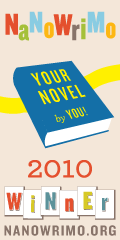 I have to start this post by yelling very loudly “I DID IT!” I reached 50,000 words on the 30th November (today) at 4.10pm Australian time. I’d actually fallen behind my word goal the last few days, meaning I had to write around 2,100 words today to hit 50k. It was very exciting putting my 50,000 words into the NaNoWriMo word count evaluator and receiving my winner’s certificate. Thank-you so much to everyone who cheered me on and supported me throughout the month of November. And in case you don’t believe me, here’s my NaNoWriMo page (complete with my final word count).




 Jo Hart - Author