Category Archives: Writing skills and techniques

More Helpful Writing Sites and Blog Posts

Fresh back from my holiday away I thought it was time for another post on helpful sites and blog posts I’ve come across in the past month.

Twitter Chats for Writers

A comprehensive list of the various twitterchats for writers (from children’s writers to script writers to genre writers) and the days and times they take place. It also outlines what twitterchats are and a few tips for those who are new to twitterchat.

25+ Favourite Twitter Hashtags for Writers

A list of the best hashtags for writers on Twitter (with links).

Three Act Structure

Jenn Johansson posted on her blog this great article about the three act structure of a novel, including a diagram of what the 3 act structure looks like.

Three Simple Stages of Self-Editing

If you are in the process of editing or about to start editing your novel then Jody Hedlund’s blogpost is worth a look. She describes the three main types of edits: Substantive/macro-edits; line-editing; and copy-editing/proofreading.

Workshop: Writing the Novel Synopsis

This in-depth article by Sheila Kelly sets out step by step how to write an effective synopsis for your novel.

Secrets of a Great Pitch

If you ever go to a writer’s conference or happen to meet an agent in an elevator, do you have a pitch prepared? Literary agent Rachelle Gardner outlines the important points you should include when pitching your novel (and also what you should avoid).

Process of Writing: From Draft to Published Novel

In this four minute video author Kate Forsyth describes her writing process, with visual examples, from the initial idea all the way through to receiving her author’s copy of her book. It’s a bit of insight into the entire process.

Hopefully there is a little something here for everyone, no matter where you are on your writing journey.

The Revision Process

Back in February I talked about how I planned to do my first lot of revisions once I finished the first draft of my manuscript. Now I have finished those initial revisions, I am now doing more revisions (does it ever end !) so I thought I would dedicate a post to what my focus is in this part of the revision process. First a brief recap of what I did for my first lot of revisions.

FIRST ROUND REVISIONS

Main focus: Structure and technical elements

1. Listen to chapter read aloud on ywriter and highlight flaws.

2. Read chapter, fix spelling and grammar and make additional notes.

3. Go back over highlighted parts of text and rewrite (highlighted parts generally indicate telling rather than showing and awkward phrasing)

4. Read aloud chapter to myself and fix anything else that stands out.

SECOND ROUND REVISIONS

Main focus: Tightening manuscript and fixing plot flaws

1. Delete all unnecessary words, descriptions and anything not relevant to the plot. This includes getting rid of words like ‘that’ and backstory that contributes nothing to the plot. I also deleted the entire prologue.

2. Make a list of plot holes then go back and fix them.

3. Rewrite beginning (multiple times) until it hooks the reader.

4. Raise the stakes! Delete anything boring and add more conflict.

5. Restructure chapter breaks. Instead of ending chapters at mundane natural breaks (like falling asleep at the end of one chapter and waking up the next morning at the start of the following chapter) use chapter breaks in high-tension places to hook the reader into the next chapter.

6. Create more natural dialogue between characters.

7. Work with critique partner to pinpoint flaws I have overlooked and to see what impressions a reader would have of the manuscript in its current state.

What do you do when you revise? Do you follow a similar structure or do you revise in a completely different way?

How having a critique partner can improve your writing

Once you’ve finished your manuscript and gone over it with a fine tooth comb, the time comes to consider, “What will readers perceive as they read my book, and, more importantly, will agents/publishers take one look at my work and throw it in the trash?” This is when having a critique partner can be invaluable to your revision process. I’ve recently finished my first couple of drafts and have hooked up with a critique partner. Even though we’ve only exchanged a couple of chapters my novel is already reaping the benefits. Here are a few ways having a critique partner can improve your writing:

1. A critique partner looks over your manuscript with fresh eyes. When you’ve been immersed in your book for so long it can be hard to distance yourself enough from your novel to see the little things. One thing I didn’t notice after my first round of revisions was just how much I used the words ‘that’ and ‘was’ in my writing. I know these are problematic words when overused, but I guess in the course of my revisions I overlooked them. When my critique partner sent back my first chapter with all the words ‘that’ and ‘was’ highlighted I realised just how much I used them.

2. A critique partner has no preconceived notions. As the author of your novel you know your characters inside out, you know the world you’ve created to the tiniest detail and you know the entire backstory of your storyline. Because you know everything about your characters, world and plotline you may unknowingly forget that your readers don’t know what you know and you unwittingly leave out necessary details. A critique partner reads your manuscript with none of the preconceived ideas you have and can point out where your story becomes confusing.

3. A critique partner can act as a beta reader. Your critique partner will read your story as a reader would read it. When I critique I tend to write notes on my first impressions as I read and ask the questions a reader would be asking. This helps show you how your future readers, or more importantly an agent or publisher, would be thinking as they read your work. If your critique partner is confused, you can be sure an agent/publisher/reader will be confused too. If your critique partner tells you a certain scene makes their eyes glaze over, you can be sure an agent/publisher/reader’s eyes will be glazing over too (and you can be sure they’ll be putting the book down).

4. A critique partner can offer you constructive criticism. Unlike a beta reader (someone who reads your work from the perspective of a future reader, ie: someone in your target readership), a critique partner is a writer too, so they will read you work from the perspective of a writer. This means instead of just telling you a certain scene isn’t working, they can actually articulate why it isn’t working.

5. Being a critique partner helps you see flaws in your own writing. Critiquing someone else’s work can make you become more aware of your own writing and your own flaws. You may notice in your partner’s writing a tendency to over-describe characters physical attributes, only to realise you’ve done exactly the same thing in your own novel. I’ve also found that after looking over someone else’s work with a critical eye, when I go back to my own work I retain that critical eye and pick up on flaws in my own writing I missed before. It helps me stand back from my own work.

If you do find a critique partner keep a few things in mind as you critique and receive critique:

1. Be constructive. For example, if you feel your partner’s characters are flat, try to explain why. Remember the point of critique is to help the other person improve.

2. Don’t rewrite the story for them. While it’s okay to suggest rewording a sentence to make the meaning clearer, don’t write the sentence for them. It’s their work, and as tempting as it is to write it how you think it should be written, you need to realise the story is their baby. Imagine how you would feel if they started rewriting your story! Offer suggestions and act as a guide, but don’t take over.

3. Be respectful. I believe in being totally honest when I critique, but there’s a difference between being honest and being nasty.

4. Include the positives as well as the negatives. Don’t forget to tell your partner what is working well in their story.

5. Be open-minded when receiving critique. If you partner up with someone you must be prepared to take any criticism they give you and not take it personally. Don’t sign up for a critique partner if you just want to hear good things about your novel. When I put up my ad for a critique partner I said straight out that I would be honest when I critique and I expected the same in return. If I wanted to hear only good things about my novel I could have easily given it to my sister and had her tell me how much she liked it (because I know my sister is too nice to hurt my feelings, and I love her for it). But I wanted honest critique from another writer, someone prepared to rip my manuscript to shreds, because that is the only way I can improve as a writer. Sure, you might feel like crying the first time you receive critique back on your novel, but once you take a deep breath and remember your critique partner is only there to help you, you can appreciate their honesty and start using their advice to help you create a better story.

One last piece of advice…

In the end remember that your novel is your baby.

As a mother lots of people have given me advice over the years on how I should raise my kids (if you have kids you’ll know what I mean!), and that’s fine, everyone has their own opinion on what works best for them and their kids, but I only listen to the advice I think will work for my kids and disregard the rest. When I was a new mum I was overwhelmed with advice (sometimes conflicting advice) and I felt obligated to take it all. In the end I realised that it was my child and, as much as people were trying to help, only I knew what was best. Once I realised this I was a lot less stressed.

The same thing can be applied to your novel. In the end it is your story and you don’t have to feel obligated to take all the advice given to you. Do what’s right for your novel. And the same applies for your critique partner too. You can give advice and critique, but don’t feel hurt if your partner doesn’t apply everything you suggest, because it is their baby.

If you are looking for a critique partner, here are a couple of links to sites with critique connections (both are for YA/kidlit writers, so if you write outside of those you may have to do a search):

Critique Connection – Kidlit.com

This is where I found my current critique partner. You can either scroll down the list of people who have already posted an interest in finding a partner and e-mail them, or if none there seem like a good match, then post a little about you and your novel and leave your e-mail. Writers here range from picture book writers to young adult writers.

Crit Seekers – YALitChat

This forum is dedicated mostly to young adult writers, but you may also find som middle grade writers too. Scroll through the comments to seeif anyone might be a good match, or post your own comment describing what your novel is about. You will need to join to be able to post (but it’s well worth joining anyway if you write YA).

Many cities also have critique groups. Check out your local library or do a search on the internet to see if there are any in your area.

How has having a critique partner helped your writing? Comment below and share.

Helpful Writing Sites

It’s time for another blog post on helpful writing sites.

YA Lit Chat

This is a writing community forum for those who write Young Adult, although they also have sections for Middle Grade and picture book writers. Some of the great sections they have include: Query Kick Around, where you can post your query to have others critique it; First Pages Critique, where you can post your first five pages to be critiqued; and Agent Insider, which lists agents who represent YA. YAlitchat also hosts a chat once a week on Twitter at 9pmEDT on Wednesdays (which just so happens to be 11am Thursday for me as I’m in Australia). These chats are a great way to connect with other writers and have guests such as agents and published authors to answer your questions. Just use the #yalitchat hashtag.

The Kill Zone

The Kill Zone consists of seven authors who each take a turn at blogging over the week. This blog is filled with great writing tips on the various aspects of writing a novel. Although the authors involved are all mystery/thriller writers their advice is applicable to writers of any genre.

Promptly

Looking for some inspiration to get your creative juices flowing? Zachery Petit offers writing prompts as well as some other writing tidbits.

And here are a few posts worth mentioning:

Top Ten Things I Know About Rewriting

A fantastic post on rewriting by Alexandra Sokoloff. She gives an in-depth look at revising a novel. It would honestly have to be the best post on rewriting I have come across. If you are serious about revising your novel you should check out this post.

Critique Connection

Are you looking for a critique partner for your WIP? Mary Kole has posted this on her kidlit website for writers of YA/MG/PB to hook up and find the perfect critique partner.

NaPiBoWriWee

In November I talked about NaNoWriMo (National Book Writing Month). NaPiBoWriWee (National Picture Book Writing Week) is a spin-off of NaNoWriMo created by Paula Yoo. The idea is to write 7 picture books in 7 days. (I will be covering this more next week.)

If you have come across any other helpful writing sites or posts feel free to share them with us in the comments (and links would be great!)

Something Fun That Can Also Help Your Writing Revision

Since it is my birthday this weekend I thought I would do a post on something fun.

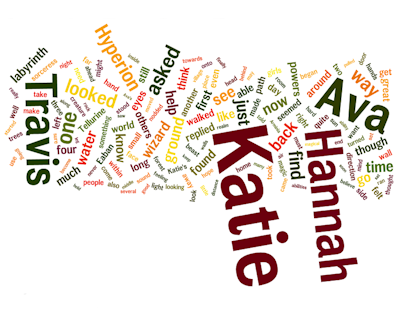
Wordle is a great little website that allows you to create word clouds with any text. All you have to do is copy and paste the text you want and Wordle automates a word cloud for you. The more frequent words show up as bigger text. You can then play around choosing a colour scheme and font. Just for fun copy paste your current writing into Wordle and see what you get. Here is what the first draft of my current wip looks like as a Wordle:

Katie, my main character, shows up as the most frequent word.

Wordle automatically takes out common English words like ‘the’ and ‘and’, although if you go to ‘language’ you can add those words back in (I tried it and ended up with ‘the’ and ‘and’ taking up nearly the whole Wordle). You can also remove individual words from the Wordle yourself if you want by right-clicking on them. I took out all the character names from mine to see what it would look like without them. Here is what it looked like:

‘Asked’ and ‘one’ now stand out the most.

While it is fun to make Wordles for your wip (or any other text for that matter), they are also a neat little way to see if there are any words you are overusing in your writing. For example, when I look at the Wordle of my first draft (the one without the character names) I can see the word ‘just’ stands out far more than it should, so now as I edit I am looking for instances where I’ve used ‘just’ so I can cut down on its use in my novel. Wordle also has an option where you can look at exactly how many times each word in your text is used. My highest frequency word was ‘the’, which I used over 6000 times.

Just a little note: The word ‘that’ is often overused and unnecessarily included in writing so watch out for it. It happens to be one of the words counted as a commonly used English word, so if you want to check for overuse using Wordle you will either need to include commonly used English words or check the list showing how many times each word was used.

I hope you all have a bit of fun with Wordle. I would love for everyone to leave a comment on which word stands out the most in your Wordle 🙂

Writing Action Scenes

Just recently in a writing forum where I am a member someone posted an fight scene for critique. Between offering critique on this particular scene and revising several chapters of my own novel involving action scenes in the past week I wanted to share some tips on how to write an effective action scene. Action and sex seem to be the two hardest types of scenes to write, so hopefully these tips will help with the action.

– The first thing you might want to do is to watch a few action movies. If you are intending to write a fight scene, try watching movies with fight scenes using the same kind of fighting techniques as you want to write (for example if you are writing a scene where the characters are boxing you might want to watch Rocky or if you are writing a scene with a sword fight you might watch Gladiator or even Star Wars). As you are watching take note of how the characters move.

– Something else you might like to do to help get your head inside your characters as they fight is to try out the movements yourself. Imagine yourself throwing that punch or swinging that axe. What does your body do?

Use short sharp sentences. Action scenes should be fast-paced and the best way to achieve that is to use short sharp sentences eg: “A hard boot connected with his stomach. He gasped for breath.”

– … but vary sentence length to avoid monotony. If every sentence is the same length it becomes boring for the reader eg: “He lunged forward. The swords clashed. He pulled away.” Compare this to, “He lunged forward. The metal swords clashed together. He pulled away.”

Show, don’t tell! I’ve talked about this before, and it is an important aspect of portraying realistic action scenes. Consider your characters’ five senses as you write the scene. Describe what it feels like when he is hit. Can he smell the blood or taste it in his mouth? Is there sweat in his eyes so it is hard to see his opponent? What sounds do the swords make as they connect? Bring the reader into the scene so they can experience it with the characters, rather than just watching it from the sidelines.

Show how your character feels. Does the sight of blood make your character feel sick? Does your character enjoy the satisfying crunch of a bone snapping? Who your character is will define how they feel about the action taking place. This is a good opportunity to flesh out your character’s personality. How does your character react to life-threatening situations? Does fighting go against every moral fibre in your character’s body or is it just a way of life?

Dont’ forget about your characters’ motivations in the scene too. Are they fighting for their life? Is there some prize at the end? Keep their goal clear in your mind as you write the scene. The higher the stakes the more involved your reader will become in the scene. Make the reader want to root for your character. eg: “Sarah gritted her teeth against the pain. Her sister was depending upon her. She couldn’t give up.”

If you have any other tips you have come across to make an action scene really come alive, I would love for you to leave a comment and share it with us.

POST SCRIPT:

I just had to add in a couple of links to some great action writing advice from author A.J. Hartley that I came across today.

Writing Action Scenes

Writing Action II: Battles

Being Flexible With Your Writing

“Write with the door closed, rewrite with the door open.” STEPHEN KING

I read that quote this morning and I thought it really resonated with the topic I was intending to blog about today: being flexible and keeping an open mind when writing. When writing the first draft you probably have a good idea in your mind of what you want to write about, you may have even planned everything out and written in down. So you shut out the world and just write, getting all your ideas down on paper, then comes the rewrite and this is when you need to keep an open mind.

As a teacher, and particularly as a substitute teacher, I find that being flexible is an important aspect of my work. Some days I walk into a classroom to teach for another teacher and they have the day planned out for me, other days there is no plan at all and I have to come up with a days worth of lessons on the spot. Every day is with a different class too, so I never know what to expect when I walk into the classroom. Some days I have a lovely well behaved class who do all their work, other days I have a volatile mix of students who like to see how far they can push me. I think being flexible as a teacher can be transferred to being flexible as a writer.

In some parts of my novel there are scenes that fit well with my plan and don’t need much work apart from a little tweak here or there to fix the technical errors and reword the awkward phrases. Then I get to other parts and I realise I need to scrap the whole passage and write it again from scratch. Then there are the characters, who are a bit like my students. In some parts of the story they are quite well-behaved and I am happy with their characterisation. In other parts, however, they just don’t want to cooperate, there are voice issues and the characters seem flat.

It can be difficult to prune a story you have poured your heart and soul into and spent hours writing. In my first draft I had written a prologue, which I loved. It was the first thing I wrote when I sat down to write my novel and the idea for it had been floating around in my head for quite some time. I liked the way the entire passage flowed and was pleased with the imagery I had created with the descriptions, but in the end I had to cut it from the story. As much as I was attached to it I had to admit that it was unnecessary. The prologue started with characters that would not appear again in the entire story (apart from being briefly mentioned by another character) and the information included in the prologue could easily be incorporated into the story elsewhere. By cutting out the prologue I’ve created a stronger story.

As you rewrite be honest with yourself and be open to change. Be willing to stray from your original plan to make a stronger story. In my original plan I had a certain ending in mind, which I wrote in my first draft, but on reflection I realised it is not a strong ending. My original ending was really just a set up to lead into the next book (since I plan to write a series), but my novel would not work well as a stand-alone book if I ended it in that way. I had to rethink the entire ending to make it more defined and to allow the book to feel finished as opposed to a lead into the next book of the series.

When you finish your first draft try leaving it for a few days before beginning your revision and when you do start revising try to go in with an open mind and a willingness to be flexible. Let go of your preconceived notions of sticking to your plan and instead look at what works and what doesn’t. Don’t be afraid to prune unnecessary parts or rewrite entire passages to strengthen the overall story. It can be a daunting process, but in the end you will have a better story.

First draft written! Now onto the editing.

Last week I felt a great deal of pride and accomplishment as I typed the final words of the first draft of my novel.  It felt so good to know that I had just written over 50,000 words/20 chapters and got all of the plot that had been floating around in my head all typed up. But of course I am by no means finished my novel, and as much as I felt relief at finally get my entire story written down, I also knew I still had a big task ahead of me: editing.

The prospect of editing this novel is a bit scary, to be honest, since I wrote most of it without looking back, so I’m prepared for lot of typos and sentences that make no sense. In the past I have taken the approach of editing a lot as I write, constantly going back, revising and correcting. I decided to take a different approach this time around, mostly inspired by the NaNoWriMo process. So I wrote this novel without looking back, I let my muse take over and just typed, without worrying about typos and other writing disasters. Now I cringe to think what terrible descriptions, spelling mistakes and illegible sentences I will find as I proofread the finished product. Despite this, I actually think it is a good thing in a way because I will be proofreading with fresh eyes. Since I haven’t looked back since I started writing the novel it will be the first time I have read what I have written and hopefully this will mean I will more easily pick up on parts that need to be fixed.

I have a bit of a system for editing my novel, which is something else I am trying for the first time and so far I think it is proving to be helpful and efficient.

1. First I listen to the chapter on ywriter (since it has an option for the scenes to be read aloud). The voice lacks intonation and pronounces some words wrong, but it’s good being able to listen to the words read out and is helping me pick up on any typos (for instance, if I’ve written ‘form’ instead of ‘from’) or sentences where I’ve repeated myself. Sometimes when reading your mind doesn’t pick up on these errors, and even when reading aloud to yourself your mind reads as you think it should read, rather than what is written, so you miss those little errors.

2. As I listen to ywriter I fix up those errors as I go, but I also make notes on areas that need more description, more detail or need to be reworded.

3. After listening to ywriter, I go back and read the chapter in my head, making more notes. I’m using a colour-coding system: yellow highlighter for parts that need to be reworded; green highlighter for parts that need more description; purple highlighter for parts that need more detail (this is different to description – it means I need to add more content to the scene); and blue highlighter  for parts where I believe I am telling more than showing. I also write any extra notes in red, such as ‘check if this part is consistent with the letter from the first chapter’.

4. I then go back and fix up all the parts I highlighted, adding more description/detail or rewording where necessary.

5. Finally, when I believe I fixed everything in the chapter, I read it aloud to make sure I haven’t overlooked anything and it sounds alright when read with proper intonation. Then it’s onto the next chapter.
With my shorter stories I usually like to print out the story so I can read the words on paper and scribble notes with pencil in the margins, but considering the length of this story, I decided to skip this step (too much paper and ink!).

I really want this novel to be perfect because I have every intention on sending it off to publishers. I’m in the process of proofreading and editing chapter four at the moment (I’m up to step four and procrastinating because there is a lot that needs fixing in this particular chapter). Once I finish proofreading and editing through the entire novel I am hoping to get a couple of beta readers to read through the entire novel. The role of a beta reader is to read through and pick up any spelling or grammatical errors/plot inconsistencies/character flaws/etc. Basically it means having a fresh pair of eyes looking over the story and giving a different perspective.

I’m really very excited about this novel 🙂

Show, Don’t Tell

One of the most important aspects of ‘good’ writing is the author’s ability to show rather than simply tell when writing. What does that mean? It means instead of simply telling the reader what is happening, you need to show them and make them feel as though they are a part of the story. When setting a scene or describing something try not to tell the reader what something ‘is’, instead allow the reader to experience the scene through the use of the five senses. What can you see? What can you hear? How does it feel? How does it smell? How does it taste? By incorporating the five senses when describing something, the reader can become immersed in the scene or story. The reader can put him or herself in the character’s position and relate to what is happening.

In class I sometimes do a writing activity with my students that I picked up from another teacher when I was doing my teaching rounds at university. The activity is called ‘Show, don’t tell’. I write a simple sentence on the board, for example: “It was a hot day.” The students must then rewrite this sentence using the ‘show, don’t tell’ technique and incorporate all five sense to create a more descriptive and engaging version of the sentence on the board. So if I take that simple sentence, “It was a hot day” and use ‘show, don’t tell’, I might end up with something like this:

“I squinted as I stepped out into the blazing sun, its yellow glare almost blinding me. The air carried the scent of burnt eucalyptus leaves. The crickets chirping, hidden from sight, were loud and clear: the quintessential sound of Summer. I had barely been outside for a few minutes, but already I could feel my skin beginning to burn under the sun’s intense gaze. Beads of sweat trickled down my face and onto my lips, filling my mouth with their salty taste…”

You probably wouldn’t go that over the top in your descriptions normally, but you can see how a simple sentence that merely ‘tells’ us that it is a hot day, can be transformed into a much more descriptive piece that shows the reader that the day is hot. You will notice that not once in this description do I use the word ‘hot’, but the reader does not need to be told that it is hot, they can infer this for themselves through the descriptions used.

I know that when I am writing, I can sometimes forget to show and I only tell what is happening, but when I go back to edit I pick out those offending sentences and rework them to ensure they are showing what is happening and not just telling.

I’ve just added a short piece to my short story collection titled ‘Once Like Them’, I think it somewhat exemplifies the way in which the concept of ‘show, don’t tell’ can be incorporated into writing.

I would encourage anyone who wishes to improve their descriptive writing to have a go at the ‘show, don’t tell’ exercise. Just think of a simple sentence, then rewrite it using all five senses.

25,000 words in one month

NaNoWriMo is officially over. Most NaNoers were aiming to write over 50,000 words in the month of November, but I always knew that goal would be little lofty for me due to work and being a mum to two young children. However I am extremely pleased with what I did achieve during NaNoWriMo as 25,000 words in one month is still quite an effort and has launched me over the halfway mark of my novel (considering I had already written a few chapters before NaNo officialy started). But even more than getting so much written in such a short space of time, NaNo has given me renewed motivation and momentum on my novel, and that is the real reward for me at the end of this endeavor.

It has been a new experience for me to push myself to churn out so many words in short spurts. Two methods I used during NaNo were Write or Die and Rat Races. Write or Die is a program where you set a time or word goal and then get ‘punished’ if you stop writing before reaching that goal. I chose the mediocre punishment of having a loud noise sound if I stopped writing for more than a few seconds. This was a real motivator for me because usually I was writing while my baby was napping, so I did not want that noise to sound and wake her up! However it was not as harsh as the punishment of having your work start erasing itself. Rat Races were writing races I participated in with other NaNoers on a writing forum. Basically someone would set a start and finish time and anyone who joined in had to write as much as they could in that time bracket to see who could write the most. The good thing about these methods is that I was able to achieve a lot of writing that I may have otherwise procrastinated over. However, I guess the down side of these methods is that you end up just writing without thinking and as a result could write absolute rubbish. I’ve yet to go and read over what I’ve written during NaNo, and I’m a little scared of how much editing I may have to do!

I have learnt a few things as a result of NaNo, though, which I think will help me with my future writing. First of all I have shown myself that if I use my spare time effectively I can get a lot written. I have also found that the best cure for writer’s block is to just write, even if the end result needs to get cut in the editing process, at least it has helped the plot to progress and allowed me as the writer to regain momentum again. And finally, even if I only write 50 words a day, it still all adds up in the end and it is worth just writing something everyday as it helps keep the story alive in my mind.