I’ve been working on my pitch for my YA fantasy novel this past week and I couldn’t help feeling my pitch wasn’t hooking the way I wanted it too. So I came up with a little exercise to help inspire me to make my pitch hook more and I believe it has helped me write a more effective pitch. I thought I would share it with my fellow writers.
STEP ONE
Go to your bookshelf and find books aimed at the same age group and same genre (if possible find books with a similar premise/catalyst) as your novel. For example, my novel is a YA fantasy where the main character is transported to a strange land, so I picked books like The Wizard of Oz and The Lion, the Witch and the Wardrobe.
STEP TWO
Have a look at the blurbs of each book, then on some note paper (or on Word) write out a blurb for your own story based on the blurb for each book. For example, this is the blurb on the back of Alice in Wonderland:
When Alice decides to follow the white rabbit down a rabbit hole, it is the start of a most extraordinary adventure in the nonsensical world of Wonderland.
There she meets some strange and delightful characters, including the King and Queen of Hearts, the Mock Turtle, the Mad Hatter, the March Hare, the Duchess and the grinning Cheshire Cat.
Now here is the blurb again rewritten using my own novel:
When Katie is transported to a strange woodland, it is the start of a dangerous and magical adventure in the mysterious parallel world of Middle Realm.
There she meets new friends and enemies, including oddball Travis, twins Hannah and Ava, an old healer woman, a reclusive wizard and the foot soldiers of an evil sorceress.
STEP THREE
Grab a highlighter and go through all your blurbs (I ended up with six altogether). Highlight the lines that stand out at you. For example, in the blurb above I highlighted ‘the foot soldiers of an evil sorceress’.
STEP FOUR
Rewrite the highlighted parts on a separate piece of paper and cut them out individually (or if you can’t be bothered doing that, you could just cut out the highlighted parts without rewriting them).
STEP FIVE
Rearrange them until you work out a suitable order and stick them onto a piece of plain paper in that order. Use a pen to fill in parts that are disjointed or cross out parts that are repetitive. One of my blurbs was in a different tense to all the others, so I had to change the tense with that part to make it fit.
STEP SIX
Write it out neatly in its new form. Use this ‘blurb’ as inspiration for writing your pitch. Just remember when you write your pitch to avoid ambiguous words like ‘mysterious’, etc., which are often used on book blurbs. And please DO NOT plagiarise the wording of the original book blurbs in your pitch. Make the pitch your own. This is all about inspiration, not copying from other books.
Have fun with it and see if you can’t improve the hook part of your pitch.
Before I introduce my guest poster I want to apologise for my lack of posts this month. For anyone who follows me on Twitter you will know I had some bad news early this month and I’ve been having a hard time dealing with it. I was feeling guilty about my lack of posts, so the lovely Susan Sipal of Harry Potter for Writers kindly offered to do a guest post for me.
Today Susan will be writing on the topic ‘Go Where It’s Scary — Into the Abyss’. Welcome Susan.
Years ago, whenever I was creatively procrastinating upon a tough job at work, or doing my best to avoid a task that involved conflict, a guy in my office would give me some of the best advice I’ve ever gotten in life: Go where it’s scary.
The only way to work through the problem, to get to the other side, is to face it head-on. Whimping out and avoiding it, as I liked to do, truly didn’t do me any good. It just prolonged the pain.
I’ve always remembered my colleague’s advice, and that phrase, “Go where it’s scary,” comes to mind whenever I find myself dragging toward something I dread but know that I must do. This is especially true with my writing. Being the polite Southern girl that I am, I often hesitate to inflict conflict upon my characters, or even worse, have them confront and deal with their innermost pains and fears.
As in life, confronting and travelling through our fears is an essential part of being human, it’s even more so with our characters, our heroes. And no part of story construction addresses “go where it’s scary” more directly than the approach to the innermost cave of the Hero’s Journey.
The Hero’s Journey and its Abyss, or Inmost Cave, is a concept described within Joseph Campbell’s groundbreaking The Hero With a Thousand Faces. A comparative mythologist, Campbell studied myths separated by continents, centuries, and cultures and discovered that most shared a basic framework, the hero’s quest, which he broke down into 17 steps. Christopher Vogler, a scriptwriter and film producer, simplified Campbell’s work into 12 steps in The Writer’s Journey, making it more accessible to writers and the film industry. Campbell’s and Vogler’s Journey have been used in storytelling in everything from Star Wars to About a Boy to Harry Potter to insertyourowntitlehere.
At the heart of the Hero’s Journey is the sending forth of the hero from his home clan and his victory over their adversaries, which culminates in his triumphant return with a reward that enriches the clan as a whole. You can see why this basic story structure would have primordial appeal to the human psyche — it is how any human unit, whether that unit be a clan, a family, or a nation — has survived and prospered throughout millennia.
The Abyss is the point in this journey where the heroine approaches her most intense conflict, her Ordeal. It is in the innermost cave that she must face and conquer both her outward foe and her own personal demons. Cave analogy harkens back to our days when the darkest places we had to fear held deadly creatures that often lurked deep in the places we called our homes. The abyss, or underworld, was the place of loss, where all bodies must eventually travel…that final, unknowable journey.
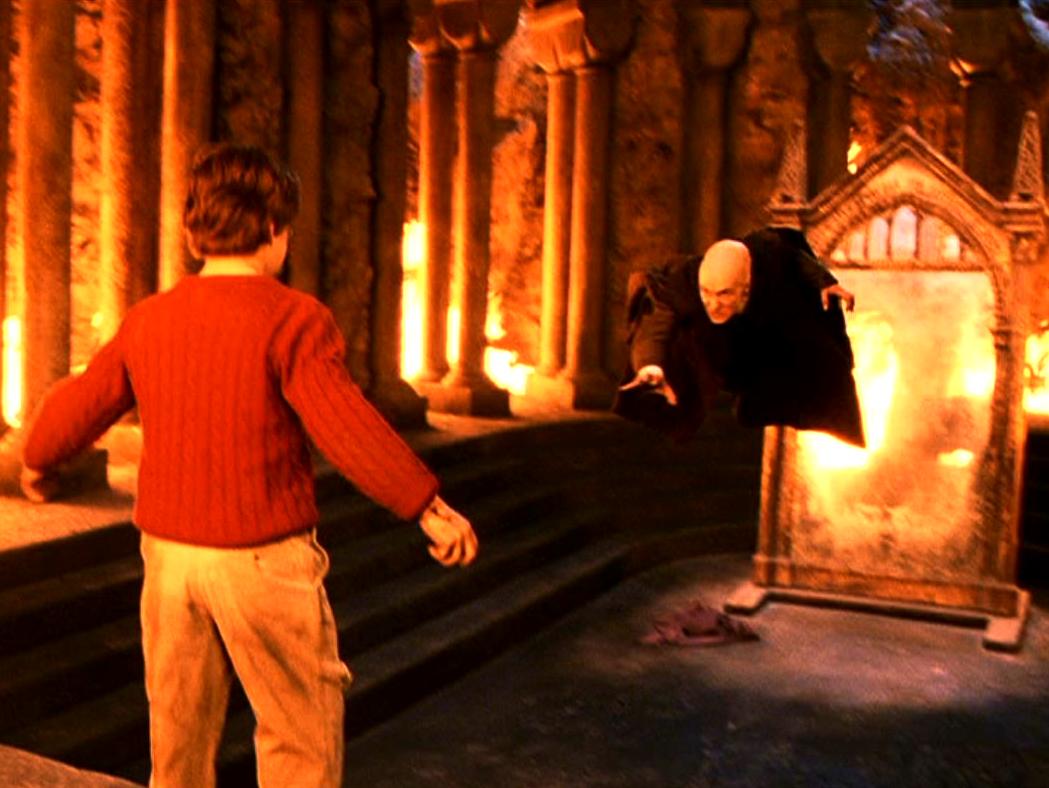
Whether in the underground, snake-filled “Well of Souls” where Indiana Jones recovers the ark but loses it to the Nazis, or the lonely, cave-like home of Will Freeman in About a Boy where Will must confront the emptiness of his life, to the underground chamber beneath Hogwarts where Harry confronts Voldemort and the loss of his parents in Sorcerer’s Stone/Philosopher’s Stone — modern storytellers are still using underground/cave imagery to set their Ordeal.
In the abyss, the hero meets death and triumph over his deepest fears, which symbolizes his death to his old life and resurrection to the new. Victory is won — whether that triumph is achieved through vanquishing the antagonist or through atonement with his Shadow. Or, as Joseph Campbell said, “It is by going down into the abyss that we recover the treasures of life. Where you stumble, there lies your treasure.”
And if our hero can do it in a story, then we can do it in real life. We live vicariously through our hero’s success. If done well, when the book is closed or the movie concluded, we then feel equipped to go back into our life and confront our own demons and monsters. This is the heart of catharsis, and this is why the bestselling books and best remembered movies are those where the hero triumphs over a tremendous obstacle with deep, personal ramifications. It does not matter whether those obstacles are pitched on the intensely personal level or the high-stakes world-wide scale.
As writers, we must remember to send our heroine into the heart of fear. She must go where it’s scariest for her to venture, face those fears head-on, triumph and be forever changed. Only in this way can she return to her world to enrich her clan…and our reader.
Susan Sipal is a writer and mother from the United States. She is also a Harry Potter analyst and speaker. She writes the blogHarry Potter for Writers.
Picture credits: National Geographic, Joseph Campbell’s The Hero With a Thousand Faces and Warner Brothers’ Harry Potter and the Philosopher’s Stone.
I have to start this post by yelling very loudly “I DID IT!” I reached 50,000 words on the 30th November (today) at 4.10pm Australian time. I’d actually fallen behind my word goal the last few days, meaning I had to write around 2,100 words today to hit 50k. It was very exciting putting my 50,000 words into the NaNoWriMo word count evaluator and receiving my winner’s certificate. Thank-you so much to everyone who cheered me on and supported me throughout the month of November. And in case you don’t believe me, here’s my NaNoWriMo page (complete with my final word count).
Now onto the helpful websites and blog posts for the month of November. There aren’t quite as many as usual, since I’ve been writing more than scouting for sites, but there were a few good ones. I’ve even included a few at the end for those finishing up NaNoWriMo and in need of a laugh.
The bluestocking blog did a great round up of helpful and insightful posts relating to NaNoWriMo earlier in the month, but there are quite a few helpful writing links in there worth checking out even though NaNo is now over.
The first post in a blog series on writing novel queries, this post outlines the five elements that should be included in your query, and follows up with some examples.
Anyone who is an official NaNoWriMo participant would have got this in their inbox during November, but if you’re not an official participant or you never got around to opening the e-mail you should read this. Quite funny.
Humourously outlines all those amateur mistakes we writers make when we first start writing by speaking with a fictional character who is the result of bad writing. (I’m sure a few of our NaNoWriMo characters are still in this stage until we go back and start editing.)
Weren’t we all that naive when we first started out, before we started reading agent blogs and realising there is more to writing than just slapping words on a page? I got a good giggle from this video.
A big congratulations to everyone who particpated in NaNoWriMo this month, whether you reached 50,000 words or not.
In honour of Harry Potter and the Deathly Hallows being released in cinemas this week I was asked to do a guest post on ‘Harry Potter for Writers’ on what Harry Potter has taught me about writing.
An excerpt from my post:
There have been several authors who have influenced my writing over the years. The earliest would have been Enid Blyton who first introduced me to the magic of story writing. Later, as a teen, John Marsden convinced me I wanted to become a published author. I discovered Harry Potter as a young adult while studying teaching and creative writing at university.
P.S. A NaNoWriMo update: Halfway through November and I’m happy to report I’m doing well. I’ve just hit 33k words. I had a really strong week this past week, but I’m starting to slow down again now. I’m hoping I don’t lose too much steam.
Today I’d like to welcome Catherine Johnson to my blog. Catherine is a writer whom I met through Write on Con a few months ago and we have since formed a picture book critique group together (along with some other writers we met through Write on Con). Catherine is currently beta reading my MG fantasy and giving me some great feedback.
Knowing I’m in the middle of pounding out 50000 words in a month for NaNoWriMo, Catherine kindly offered to do a guest post for my blog. So without further ado, here is Catherine with her post on writing dialogue.
Thank you to Jo for letting me guest post today. I chose to talk about dialogue and share some tips and trips. It’s something I am very interested in doing better and listening and reading good dialogue can only serve to help the cause. At the bottom of this post I have listed some of my favourite quotes from movies I watch with my kids all the time. I’m sure there are many more, if I had all day 🙂 There are 8 great tips on dialogue here: http://bit.ly/UZraC They are very specific and useful to try yourself. Everyone likes to think their character’s say things that are true to life. Have a look at the tips on this site and check the against your writing: http://bit.ly/9Q6DxY All those of us with young children are lucky that the first few tips are already taken care of. I like the last one, I might try that with my main characters. Another useful post on the subject is here: http://bit.ly/a7hQMH discussing expository dialogue, a common pitfall of writing dialogue.
Absorb all the dialogue you hear around (without being too nosy! coughs) especially from tv shows and films. Reading is also an obvious example. Have you ever read a picture book, for example, and only concentrated on the dialogue? Are there books in the library that seem to have more dialogue than others? Analyse it and see if it appears natural and see how it fits in with all those tips and tricks above. And now I’ll leave you with some of my favourite lines from movies I watch way too much!
The Bee Movie
Vanessa Bloom “It’s very hard to concentrate with that panicky tone in your voice.”
Bee Vincent “It’s not a tone. I’m PANICKING!”
Space Chimps
HAM “When are you going to stop worrying about me dad? Space is in my veins.”
Dad “And between your ears.”
—————
“Chimp up cannonball. You’re not in the circus anymore.”
————–
HAM “You’re not going to do that the whole trip are you?”
Friend “What?”
HAM “Use Chimps to replace real phrases.”
————-
HAM “I do this every day of the week (sky dive) except Monday. That’s my me day.” (I particularly like this one!)
“…this rug isn’t going to cut itself.”
G-Force
“Hey I’m nine inches tall,I only see the up-side.”
Catherine
Thank-you so much, Catherine, for your post. You’ve provided some great links. If anyone would like to check out Catherine’s blog, you can find it here: Kangaroobee’s Blog
P.S. A little update on my NaNoWriMo progress: I started out with a slow week, I was finding it hard to get motivated for the story I planned, even though I knew what I wanted to write. Yesterday I decided to throw that story in and started something completely new. I wrote more yesterday on the new story than I had all week on the first one. I’m feeling a great deal more motivation now.
For this month’s helpful writing sites post I’m going to put the links under two sections. The first section will be sites and blog posts specific to NaNoWriMo since I’ve come across a few of these in the lead up to NaNoWriMo and the other section will be for general writing sites and blog posts, so if you’re not doing NaNoWriMo you can just skip down to that section (of course quite a few the NaNoWriMo specific links have some great information for all writers, so they’re worth a look anyway).
This is where you sign up if you want to be an official participant in NaNoWriMo. You can set up a bio page, connect with fellow NaNoWriMoers and find out information about National Novel Writing Month. There’s also a handy link to the forums.
If you’re participating in NaNoWriMo and haven’t already checked out the forums you should. There are a multitude of groups you can join, from age specific groups to genre specific groups. If you put in your location when you signed up there should also be a subforum visible for your area where you can connect with others near you and find out about local events like write-ins. There are also many threads that will prove to be helpful once the madness of November begins.
One NaNoWriMoer describes a great way to organise a novel notebook in preparation for NaNoWriMo. At the end of the post she also includes some links to some writing tools that can be found online.
Still undecided if you should do NaNoWriMo or not? There’s still time to join! Johanna Penn lists some great reasons why NaNoWriMo is beneficial to any writer. I agree with every one of them.
I used this tool last year for NaNoWriMo and I don’t think I could have got as much written as I did without it. The idea is you have to keep writing until you reach the amount of time/words you set or you get ‘punished’. The punishments range from mild (an annoying noise) to severe (it starts erasing what you’ve written!). You get one pause, but once you’ve used it you can’t use it again for that session. I would use this one a lot if I got writers block, because it forced me to just write. It is also good if you are so many words off reaching your word goal for the day, as you can set the word goal you want to reach and just keep writing until you get to that goal. Don’t forget to copy and paste into your Word doc when your session is over.
Wondering if your female character is stereotypical or original? Try this flowchart. Start at the start and answer the questions truthfully to see where your character falls.
As well as outlining the number one culprit of rejection of science fiction and fantasy book queries, agent Kristen also includes a list of the top ten reasons why SF&F query letters get rejected.
This post was a lead-in to a scribechat that took place in early October, so the topic of whether your book has series potential isn’t discussed in this post. It does however have a handy little list describing the different types of series that exist.
Good luck to everyone participating in NaNoWriMo this year. For me it starts tomorrow! I’ll keep you updated on my progress throughout November.
In my last blog post when I was talking about preparing for NaNoWriMo I mentioned character bios. This week I’m going to go into character bios in-depth. I find writing outlines or bios for my main characters helps me get a good feel for my character before I start writing and I find I can slip into their voices much easier. These are some of the ways I prepare my characters:
Harry Potter
1. Character Biography/Outline Sheet
This is a page (or pages) of information/facts about my character. This is where I take a vague idea in my head and start nutting out the details of who my character is. I’m going to use the character of Harry Potter as an example to show you how I set out my character bio sheet.
Name: Harry James Potter (if my character goes by a nickname I include it here too)
Age: 11 years, born 30th July
Nationality: British
Physical features: Dark, messy hair that always sticks up at the back; green eyes; wears cousin’s oversized hand-me-down clothes; wears glasses; skinny and scrawny.
Family: Lives with his aunt, uncle and cousin because his parents died when he was a baby (killed by dark wizard, but he believes they were killed in car crash). They are a middle class family and live in a three bedroom home. Uncle works for a drilling company. Harry is treated badly by all members of the household and his bedroom is the cupboard under the stairs.
Strengths: humble, kind to others, willing to fight for what’s right
Weaknesses: quick temper, disregard for rules, curiosity that leads him into trouble
Power: Wizard (I include this one for my fantasy novels)
I may add more bits and pieces to this as I write, for example I may come back and include his address 4 Privet Drive, Little Whinging. Character sheets are a good way to keep track of details as you write so you don’t end up with character inconsistencies (eg: he has green eyes in chapter one, but blue eyes in chapter twelve).
2. Character Interview
While the character sheet gives a basic overview of the character, and interview goes more in-depth. During the interview have your character answer in their own voice. This is a good way to develop your character’s voice. These are some of the interview questions I use (and I’ll use Harry Potter as an example again). Describe your family. Parents, siblings, pets, alive, dead…
My mum and dad died when I was a baby, so I live with my mother’s sister, my aunt Petunia, and her husband, my uncle Vernon. I’m basically fungus between their toes. They dote on my cousin Dudley. He’s a spoilt brat and about as wide as two houses. Bullying me is his favourite sport. I don’t have any pets, aunt Petunia thinks animals are too dirty to be allowed.
If your house was on fire and you only had time to grab three things, what would they be?
I don’t really have anything worth grabbing, all my stuff is hand-me-downs from my cousin Dudley and it’s all rubbish.
Are you religious at all, and if so, in what way?
No. Although aunt Petunia makes us all go to church on Sunday at the local Anglican.
What is your race/social status?
I’m caucasian. I suppose you could say we’re middle class, although aunt Petunia likes to think we’re upper class.
If you are at school, do you think you fit in? If not, why? (For an adult character you can exchange school for work)
No I don’t. Dudley always made sure of that. He bullies me daily with his group of thugs. No one dares make friends with me because they’re too scared of Dudley and his gang.
What is the one thing you care about most in the world?
I don’t really have anything or anyone. I know I should say my aunt Petunia, but I doubt she cares about me. I wish I had a photograph of my parents.
If you had to spend the rest of your life doing one thing only, what would it be?
Living as far away from the Dursleys as possible.
What’s the last thing you’d be caught doing?
Bullying others
What was the best experience of your life, and why?
Probably when my parents were still alive, but I can’t really remember. I have this vague memory of this woman smiling at me, but I don’t know if it’s real or not.
What was the worst day of your life?
The day Dudley and his gang chased me into a stinging nettle bush. Uncle Vernon wouldn’t even let me put cream on the stings because he said it served me right not looking where I was going.
Describe the sort of person you’d want to marry, if you married at all.
Someone kind and who loves me for me.
What do you look for in a friend?
Someone who actually wants to hang around with me and who is a decent person (I wouldn’t want to be friends with someone who is mean to others).
If you go to school, what are your favourite and least favourite school subjects, and why? (For an adult character you can change this to work duties)
My favourite subject is sport, mostly because I know I can always outrun Dudley. My least favourite is art, because Dudley and his mates flick paint and bits of dried clay at me when the teacher’s back is turned.
If you could go anywhere in the world, where would it be?
Anywhere that isn’t Little Whinging. I’d like to find out where my parents lived and go there.
Sum yourself up in five words. (You can also ask how they would sum up other main characters in the story)
skinny, orphan, friendless, independent, smart
You might have noticed I answered the questions from the perspective of Harry as he would answer prior to the events of the books. You could also do an interview of how your character would answer during the events of the story, obviously Harry would answer differently once he’d started at Hogwarts, had made some friends and was away from the Dursleys. Here’s an exercise to try: Answer these questions from Harry’s perspective after he starts Hogwarts (or if you haven’t read Harry Potter chose a character from another book).
3. Character Picture.
A character picture helps give you a solid image of what your character looks like. Here are some of the methods I use:
Sketch – I’m not a great artist, but sometimes I like to grab a pencil and sketch out what my character looks like. What would he/she wear? What hair colour/length does he/she have? What colour eyes?
Sims – This is one of my favourite methods, especially with the more recent versions of Sims, because there are a lot of options for creating your character’s physical appearance. You can adjust skin tone, eye colour, hair style, build, clothes style, even nose and mouth shape. You can also choose your character’s personality (and in Sims 3 you can also choose life goals). When I’m done creating my character I print screen and save the picture. If you don’t have Sims, there are various sites around with ‘dolls’ you can design to look like your characters (although the problem with many of these is they don’t often have male dolls).
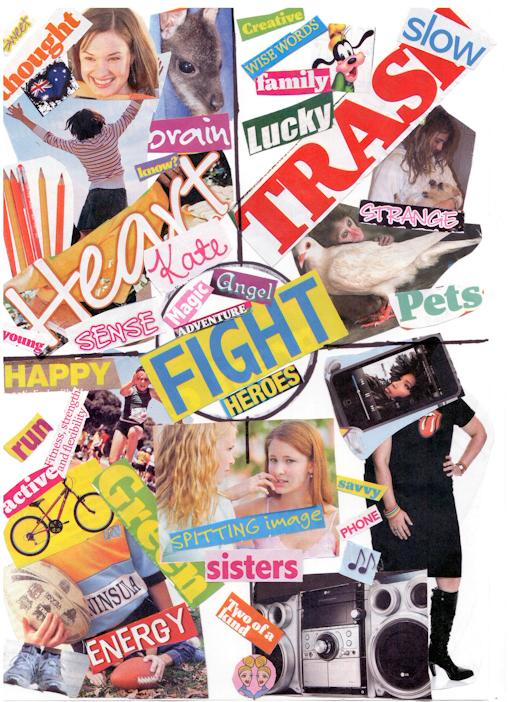
Character from my wipCombined collage of four main characters from my wip
Character Collage – For this one I grab a stack of old magazines and search for pictures relating to my character. I’ll look for people sporting the same style of clothes or hairstyle or I’ll look for objects relating to my character. For example, when doing a collage for my character Ava I’d look for pictures of people with short red hair or black clothes and pictures of ipods and phones. It’s a good way to show physical appearance and personality.
With only a week to go until NaNoWriMo begins, this week I will be focusing on my characters and getting to know them better. I’d be interested to know what other methods you use when getting to know your characters.
When I get an idea for a novel I do a basic outline. It basically forms the bones of my novel (I like to call it the story skeleton). I find an outline is particularly helpful during NaNoWriMo because it gives me a basic road map for my story, that way if I get stuck half way through all I have to do is refer back to my road map and get back on track. Since the aim of NaNoWriMo is to write 50,000 words in a month, I don’t want to get stuck halfway through because I don’t know where the plot is going. A basic outline can be a great preparation tool, and a great way to fend off writer’s block.
This is how I set up an outline; it’s a fairly basic set up, yet it includes everything you need for your story arc. (I’m going to use The Wizard of Oz as an example)
PLOT (Here I write one or two sentences to give the basic idea of the main plot – think of it as a practice run for the tagline/pitch of your story)
When Dorothy finds herself in a strange land called Oz, she must find the wizard to get back home again.
ORIENTATION/BEGINNING (This is where the story starts. It contains the inciting incident that gets the story moving towards the conflict)
A tornado picks up Dorothy’s house and whisks it away to the land of Oz. There she meets the Good Witch who tells her she must follow the yellow brick road to find the wizard.
CONFLICT/PROBLEM (What is the problem/obstacle the main character will need to overcome?)
Dorothy needs to find the wizard who can send her home. To make things more difficult, a wicked witch is trying to do her harm because Dorothy accidentally killed the witch’s sister when her house landed in Oz.
EVENTS/PLOT POINTS (Here I list the important events I want to happen in the story, it doesn’t have to list every single event in the story, just the ones that will be particularly relevent to the plot. And don’t worry if you think of more things later on as you are writing. This is just a basic outline to help keep you on track. This is the part I find most helpful when I get stuck, because I can look at my points and think, I still need that to happen.)
– Dorothy meets a scarecrow with no brain who joins her in seeking the wizard.
– They meet a tinman with no heart who also joins them.
– Finally they meet a lion with no courage who joins them as well.
– The Wicked Witch kidnaps Dorothy.
– Scarecrow, Tinman and Lion come to save her.
RESOLUTION/CONCLUSION (This is how the problem is solved and how the story will end.)
Dorothy defeats the Wicked Witch and finds the wizard. Her friends receive the gifts of a brain, a heart and courage and Dorothy is able to return home.
You’ll note I don’t mention the ruby slippers in this outline, it could be that when I start writing the story I get the idea for the ruby slippers, I can then either amend my original outline with the new idea, or just write it in as it comes to me. If the idea comes early in my writing of the story I’ll write it into the outline, but if it comes later, perhaps when I’m editing, I often don’t worry about amending the original outline.
From your basic outline you can create a more detailed outline or you might feel as though a basic outline is enough for you to go on. Once you have your story skeleton all you’ll need to do when NaNoWriMo starts is to begin fleshing it out.
Last year I particpated in NaNoWriMo for the first time, well unofficially anyway. NaNoWriMo is National Novel Writing Month. It takes place in November and the goal is to write 50,000 words in 30 days. Last year I decided to do NaNoWriMo (though I never offically joined the site because I’d technically already started writing my novel and due to time constrictions in my life at the time I knew I’d never reach 50k words). I took part last year to get some much needed motivation to get my novel written (and stop procrastinating). I got so much more out of it than I ever thought I would. Some things I learned:
1. Making Time to Write
It’s so easy to become distracted (by social media, by television, etc) that writing goes on the backburner. I had started writing a novel, but I wasn’t giving writing the priority I needed to give it. I would procrastinate and become distracted mucking around on Facebook. To reach 50k in one month I set myself a goal of writing a set amount each day, which meant any time I had spare time to write that’s exactly what I did. I didn’t waste time playing Harry Potter on PS3 or even starting that new book I bought. I wrote. NaNoWriMo taught me if I gave writing priority over time-wasting activities I could get a lot written.
2. The Cure for Writer’s Block
Before NaNoWriMo if I got stuck with a scene I would sit there and stare at the blank page and sometimes even give up, hoping it would come to me later, only to return and stare at the blank page again with still no idea how to proceed. This is usually where the procrastination would come in. I would divert back to the old standbys of social media and video games while I ‘thought’. It didn’t work too well. Procrastinating wasn’t an option during NaNoWriMo, I needed to get those words on the page if I had any hope of reaching my daily writing goal. So I just wrote, whether I was stuck or not. I found ‘Write or Die‘ was great for this. Basically you set up a word/time goal and write until you reach that goal. If you stop writing for more than a few seconds you get ‘punished’ (there are several punishment options to choose from). Maybe what I wrote during these forced sessions wasn’t the most brilliant writing and maybe I had to modify scenes later on (that’s what editing is for), but I got past my writer’s block every time.
3. Turning Off My Inner Editor
I’m a real perfectionist when it comes to writing and one thing I always used to do was edit as I wrote. I would write a scene, or sometimes even a paragraph, then I would go back and fix all the spelling errors because I couldn’t stand having them there or I would rewrite the scene again and again until it flowed just right. It made writing a long process and often I would lose steam before I ever finished the story. For NaNoWriMo I forced myself to turn off my inner editor. I made myself refrain from reading back over anything I had written until I finished that first draft completely. Sure there were lots of spelling and grammatical errors throughout that first draft and there were a lot of scenes that needed to be rewritten, but I got it written. I got the story written out to completion without losing steam. I didn’t get 50k in November, I think I only hit 30k (which was still a huge achievement for me), but I kept up the steam until it was finished (in January). The first draft is just that, a first draft. It doesn’t have to be perfect, that’s what editing is for.
I’ve decided to take part in NaNoWriMo officially this year(my NaNo page is here). Although I’m not certain I’ll reach 50k this year (I still have to balance my other time commitments), at least I’m starting from scratch this time. I’ve been tossing up between a couple of ideas, but I think I’ve narrowed it down to the one I want to write. Now to start the planning!
I know this is something I’m guilty of doing. I sit hunched over at my computer for hours at a time and I wonder why I get a sore back and neck. This is a post all writers should read and remember. Some great advice for those of us who spend a lot of time writing at our computers.
Although this post is primarily aimed at those self-publishing picture books, there are some valid points in this post for all picture book writers to consider.
Casey McCormick has compiled a post on appropriate word counts for picture books based on her knowledge as an agent intern and research (she lists her sources at the end of the post if you want to check them out).
It’s nice to see some posts on writing pb queries starting to surface around the web. When I wrote my post on pb queries a while back there weren’t many posts specifically relating to pb queries at all. Thank-you Query Shark for ripping apart a pb query this month!
Kidlit agent Mary Kole has also posted on pb queries this month. She describes how pb queries need to be simple and gives an example. (Where were these insightful posts two months ago when I was writing my pb query?)
If a publisher or agent comes across your blog and checks out your ‘About Page’ you want to present yourself in the most effective way possible. This post tells you how you can do just that.
I laughed when I read this post as I recognised all the ‘author poses’ listed. As well as being a funny look at the typical ‘author pose’, it also made me determined to make sure I come up with something original when I do my own ‘author pose’ one day!
There’s a bit of a focus on picture books this month, but hopefully there is something here for writers from all genres/stages of writing.

 I’ve been working on my pitch for my YA fantasy novel this past week and I couldn’t help feeling my pitch wasn’t hooking the way I wanted it too. So I came up with a little exercise to help inspire me to make my pitch hook more and I believe it has helped me write a more effective pitch. I thought I would share it with my fellow writers.







 Jo Hart - Author